About Eremophila decipiens Ostenf.
Taxonomic Identity and Growth Form
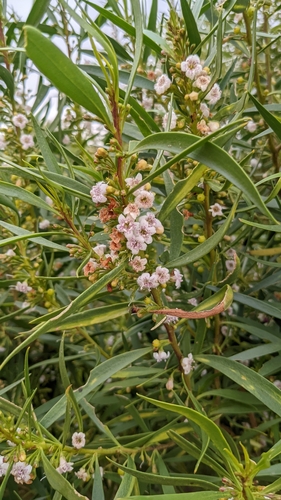
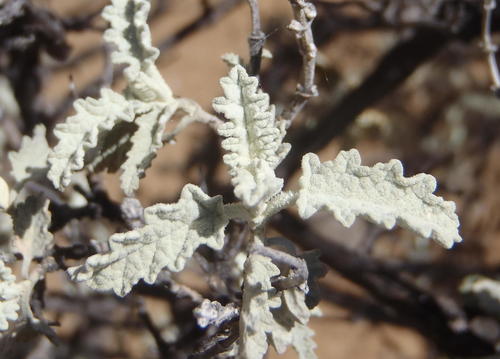
Eremophila decipiens Ostenf. is a low, sprawling shrub with many tangled branches, growing between 0.3 and 1.0 metres (1 and 3 feet) tall. Branch tips and leaves are sticky and shiny due to the presence of resin.
Leaf Arrangement
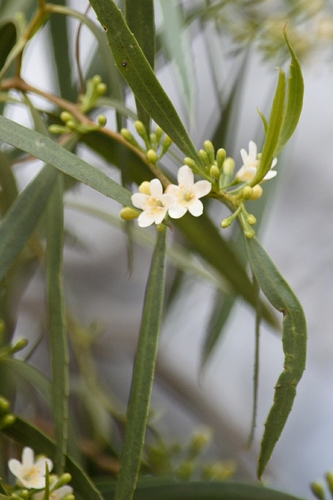
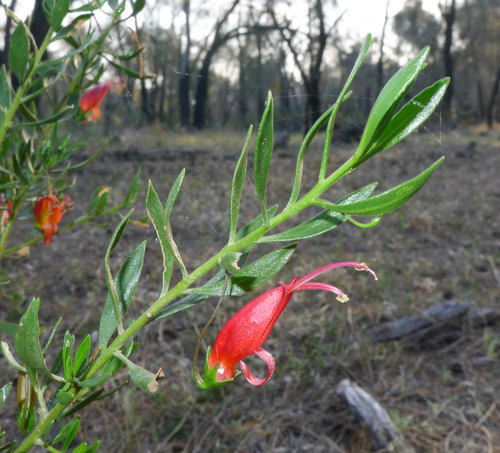
Leaves are arranged alternately, growing either densely clustered or scattered along stems. They are hairless, linear to lance-shaped, sometimes with a few irregular teeth on their margins.
Leaf Size
Most leaves are 15–46 mm (0.6–2 in) long and 1.5–9 mm (0.06–0.4 in) wide.
Flower Stalk Characteristics
Flowers are borne singly in leaf axils on an S-shaped stalk that is 11–22 mm (0.4–0.9 in) long, and at least twice as long as the longest sepal.
Sepal Characteristics
There are 5 egg-shaped to triangular, slightly overlapping sepals that are mostly 3–6 mm (0.1–0.2 in) long, slightly hairy and sticky.
Petal Structure
Petals are 15–30 mm (0.6–1 in) long, joined at their lower end to form a tube. The petal tube is red, orange, or sometimes yellow, and has no spots.
Petal Surface Texture
The outer surface of the petal tube and lobes is usually hairless, often sticky, while the inner surface is covered with short hairs. Four stamens extend beyond the end of the tube.
Flowering Period
Flowering occurs from February to December overall, though in the Esperance region it mostly occurs between July and November.
Fruit Characteristics
The fruits are dry, cylinder-shaped to almost spherical, hairless with a papery covering, and 4–7.5 millimetres (0.2–0.3 in) long.
Similar Species Distinction
Eremophila decipiens is sometimes mistaken for Eremophila glabra, but Eremophila glabra does not have the long, S-shaped flower stalk that this species has.
Subspecies Distribution Overview
Two subspecies of Eremophila decipiens differ in distribution.
Subspecies decipiens Range
Eremophila decipiens subsp. decipiens occurs throughout the south-west botanical province, and also extends north to Wiluna and east across the Nullarbor Plain to the Eyre Peninsula in South Australia.
Subspecies linearifolia Range
Subspecies linearifolia has a more restricted distribution in the eastern wheatbelt and goldfields.
Habitat Preference
Both subspecies grow in a variety of soil types, most often in Eucalyptus woodland.
Pollination Method
Most species of Eremophila are pollinated by insects, but Eremophila decipiens is one of around 40 Eremophila species that are pollinated by birds.
Horticultural Adaptability
Common called slender fuchsia bush, this species is a hardy garden plant that will grow in most soils in full sun or partial shade, and tolerates harsh drought conditions and severe frosts.
Propagation Methods
Propagation from seed is very difficult, but cuttings root easily when mist is not used.
Garden Longevity and Pruning
Plants are long-lived in gardens, and some specimens are more than 30 years old. Older specimens respond well even to heavy pruning.