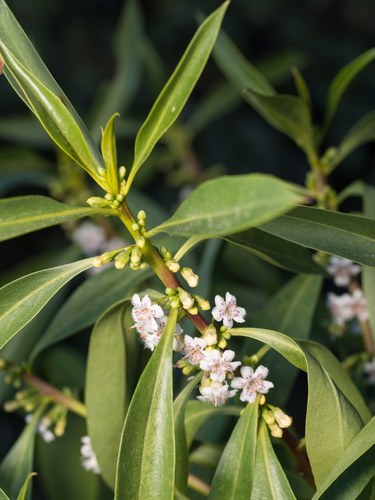
About Myoporum acuminatum R.Br.
Growth Form and Size
Myoporum acuminatum grows as a hairless shrub or small tree, reaching up to 13 metres (40 feet) in height, with a trunk diameter up to 50 cm (20 inches). The trunks of larger plants may be irregular in shape with flanges.
Trunk Bark
The bark of larger trees is greyish brown and somewhat wrinkled.
Small Branch Characteristics
Small branches are green, fairly thick and smooth.
Taxonomic Relationship with Myoporum montanum
Some authors have considered that Myoporum acuminatum encompasses the closely related species Myoporum montanum, which has an overlapping range with it. The common name Waterbush originally comes from Myoporum montanum.
Myoporum montanum Habitat and Indicator Value
This species grows through arid central Australia and coastal regions, and its presence is thought to indicate the presence of groundwater.
Species Distinction Features
The two species are difficult to distinguish because they are closely related with an overlapping range, but they can be told apart by several features: Myoporum montanum has smaller, narrower leaves, its flower sepals lack the translucent margins present on Myoporum acuminatum sepals, and its fruit is pink or light purple, compared to the dark purple or blue fruit of Myoporum acuminatum.
Myoporum acuminatum Distribution and Habitat
Myoporum acuminatum grows in rainforest or eucalyptus forest of eastern Australia, ranging from Queensland to the far south coast of New South Wales.
Horticultural Tolerance
In horticulture, Waterbush is a hardy plant that can tolerate salt spray.
Horticultural Cultivation Requirements
It prefers well drained soil in full sun, and is most easily propagated from cuttings.