About Mycteroperca rosacea (Streets, 1877)
Body Shape
Mycteroperca rosacea has an elongate, robust, compressed body. Its body depth is no greater at the dorsal fin origin than at the anal fin origin; the body is actually deepest at the anal fin origin. Standard length is 2.7 to 3.1 times the body depth.
Preopercle Structure
The preopercle has a small lobe at its angle.
Fin Ray Counts
The dorsal fin has 11 spines and 16–18 soft rays, while the anal fin has 3 spines and 10–11 soft rays.
Fin Morphology
The membranes between the dorsal fin spines are notched, and the caudal fin has a straight rear margin.
Common Coloration
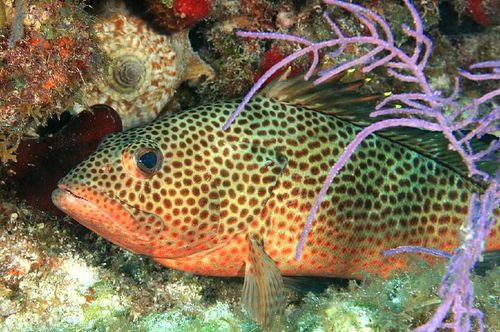
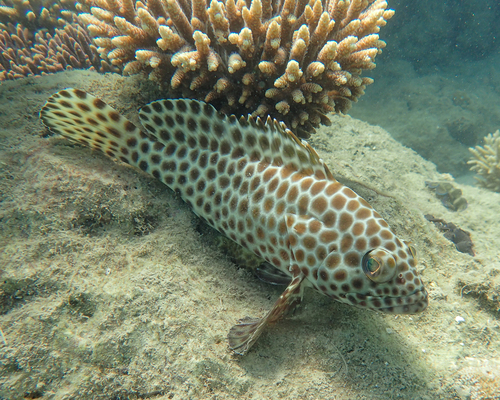
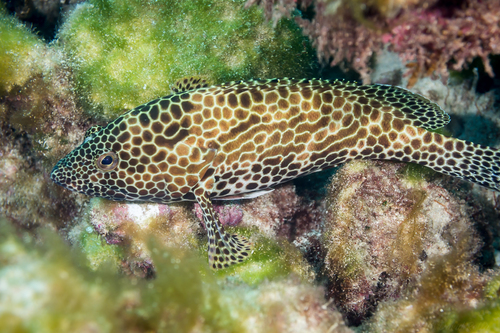
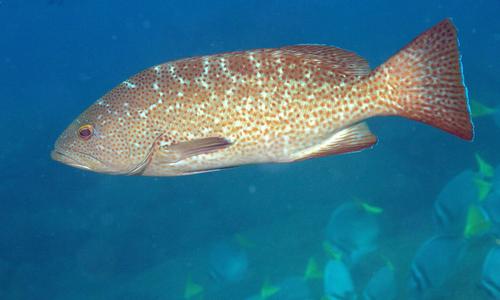
Its body color is most commonly greenish to greyish brown marked with small reddish brown spots, plus irregular pale spots and lines, and it has white fin margins.
Xanthic Color Morph
There is also a xanthic color morph where the entire body is bright yellow-orange, occasionally with a small number of scattered black spots.
Size and Weight
This species reaches a total length of 86 centimetres (34 in) and has a maximum published weight of 9.6 kilograms (21 lb).
Distribution Range
Mycteroperca rosacea is endemic to Mexico, found in the eastern Pacific Ocean. Its range extends from the southwestern Baja California peninsula south to Jalisco, and it also occurs in the Gulf of California and the Tres Marias Islands.
Habitat and Depth
This species inhabits rocky shallow water areas, with a depth range of 1 to 100 m (3 to 328 ft).
Adult Seasonal Diet
Adults are largely piscivorous: when in season, they prey on schools of Pacific flatiron herring (Harengula thrissina) and Pacific anchoveta (Cetengraulis mysticetus). When these prey are not in season, they feed on other schooling and non-schooling fishes.
Feeding Periods
Adults feed mostly at dawn and dusk, with activity peaking around 20 minutes after sunset. Juveniles are more diurnal, feeding on a diverse range of benthic fishes and crustaceans.
Reproductive Biology
Mycteroperca rosacea is thought to be a protogynous hermaphrodite, meaning sexually mature females change sex to become males later in life. This species spawns in pairs, and spawning aggregations occur from April to June.
Maximum Age
It can reach a maximum age of 17 years.
Larval Settlement
Larvae settle into Sargassum beds in rocky areas.
El Niño Recruitment Impact
During El Niño events, increased water temperature reduces the amount of Sargassum cover, which lowers this species' recruitment rate.
La Niña Recruitment Impact
During La Niña events, lower water temperatures correspond with peak recruitment for this species.