About Epinephelus guttatus (Linnaeus, 1758)
Body Shape
Epinephelus guttatus, commonly called the red hind, has a robust, compressed body that is deepest where the dorsal fin originates. Its standard length is 2.7 to 3.1 times the depth of its body.
Gill Cover Spines
The margin of the gill cover bears three flat spines. The preopercle has a finely serrated margin and projects slightly near its lower edge.
Fin Structure
The dorsal fin holds 11 spines and 15 to 16 soft rays, while the anal fin has 3 spines and 8 soft rays. The red hind's tail is slightly convex.
Body Coloration
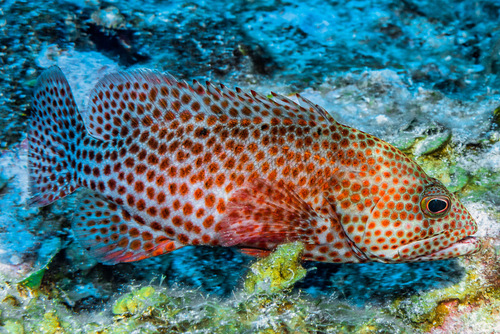
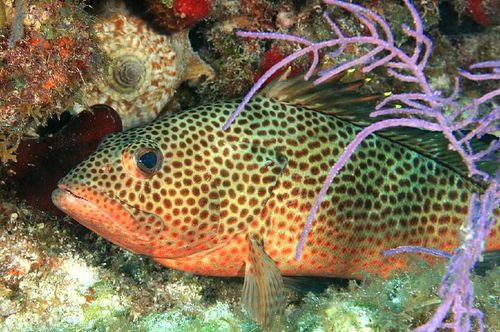
This species has an upper body color ranging from greenish grey to light brown, which fades to white on the lower body. Many well-spaced dull orange-red to brown spots cover the head, body and fins.
Flank Markings
Five indistinct oblique bars made of darker spots appear on the flanks.
Body Length
The red hind reaches a maximum total length of 76 centimetres (30 in), though most common adults are around 40 centimetres (16 in) long.
Maximum Weight
The maximum published weight for this species is 22 kilograms (49 lb).
Distribution Range
The red hind is distributed in the Western Atlantic. Its range extends from Bermuda and North Carolina along the eastern coast of the United States into the Gulf of Mexico and the Caribbean.
Southern Range Limits
While its range is reported to extend south as far as Brazil, there are no confirmed records of the species from areas south of Venezuela.
Habitat
Red hinds live on coral reefs and rocky bottoms.
Territorial Behavior
Females stay close to the bottom, while males patrol and defend a territory that overlaps the home ranges of one to five females.
Diet Components
Over 15 percent of the red hind's diet consists of mantis shrimps. Crabs are the most common food item in their diet.
Prey Species
Their diet also includes fish such as Bluehead Wrasse (Thalassoma bifasciatum), Boga (Inermia vittata), goatfishes, and small morays. Red hinds prefer feeding on shrimps and octopuses.
Reproductive Biology
Red hinds are protogynous hermaphrodites, meaning they change sex from female to male at a certain point in their life cycle. The trigger for this sex change is not currently known.
Spawning Patterns
In Puerto Rico, red hinds gather in or near established spawning grounds along sections of the insular shelf for a one to two week period, aligned with the lunar cycles of January and February. In 1992, a tagged red hind traveled over ten miles, crossed over 600 feet deep water, and passed by other spawning aggregations to reach a specific spawning site.
Early Life Stages
Little is known about this species' early life stages. On rare occasions, juveniles measuring one to two inches long have been observed moving near cover on patch reefs in moderate depths.
Lifespan
Most adult red hinds live for ten to eleven years.