About Epinephelus itajara (Lichtenstein, 1822)
Size
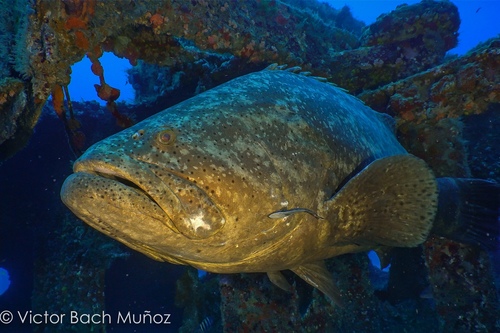
This species, commonly known as the Atlantic goliath grouper, can reach lengths of 2.5 meters (8 feet) and weigh up to 363 kilograms (800 pounds).
Coloration
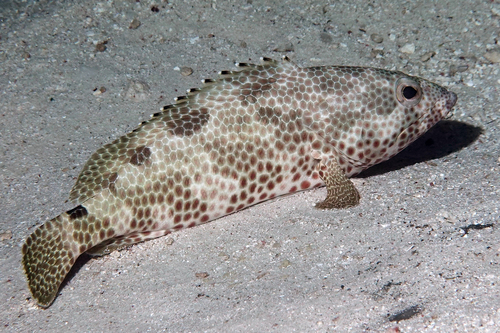
Its base body color ranges from brownish yellow to grey to greenish, and small black dots mark its head, body, and fins. Individuals shorter than 1 meter (3 feet) have three to four faint vertical bars along their sides.
Body and Head Shape
It has an elongate body, a broad flat head, and small eyes.
Dentition
Its lower jaw holds 3 to 5 rows of teeth, with no front canines.
Scales
The body is covered in ctenoid scales.
Dorsal Fin Structure
The dorsal fins are continuous, and the rays of the soft dorsal fin are longer than the spines of the first dorsal fin.
Other Fin Structure
Its pectoral fins are rounded, and are notably larger than the pelvic fins; the caudal fin is also rounded.
Diet
The Atlantic goliath grouper typically preys on slow-moving fish and crustaceans.
Adult Habitat
Adult individuals are most often found in rocky reefs, wrecks, artificial reefs, and oil platforms. They can also occur in coral reef habitats, but are far more abundant in rocky reef environments.
Juvenile Habitat
Juveniles mainly live in mangrove environments, and can also be found in holes and under ledges of the swift tidal creeks that drain mangroves.
Mangrove Nursery Role
Mangroves act as an essential nursery habitat for the Atlantic goliath grouper, and provide the specific suitable water conditions needed to nurture healthy, sustained populations of the species.
Nursery Residence Period
Juvenile Atlantic goliath groupers may stay in mangrove nursery habitats for 5 to 6 years, before moving to deeper offshore reef habitats once they reach around 1 meter in length.
Lifespan and Maturation Timeline
The Atlantic goliath grouper has a maximum longevity of 37 years, and reaches first sexual maturity after 6 years, giving it an estimated generation length of 21.5 years.
Hermaphroditism Hypothesis
It has been hypothesized to be a protogynous hermaphrodite, but this claim has not yet been confirmed.
Male Sexual Maturity
Males become sexually mature at around 115 centimeters (45 inches) in length, and at ages between 4 and 6 years.
Female Sexual Maturity
Females become sexually mature at around 125 centimeters (49 inches) in length, and at ages between 6 and 8 years.
Spawning Behavior
This species forms relatively small spawning aggregations, with fewer than 150 individuals per aggregation, and there is no evidence that the species spawns outside of these aggregations.