About Epinephelus spilotoceps Schultz, 1953
Body Proportion
Epinephelus spilotoceps Schultz, 1953 has a standard length that is 3.1 to 3.6 times its body depth.
Head Morphology
It has a flat area between its eyes, and the dorsal profile of its head is convex.
Its preopercle is rounded, marked by a shallow incision, and the serrations on the margin below this incision are enlarged.
The upper margin of its gill cover is straight.
Fin Structure
The dorsal fin has 11 spines and 14 to 16 soft rays, while the anal fin has 3 spines and 8 soft rays.
Its caudal fin is rounded.
Body Spot Pattern
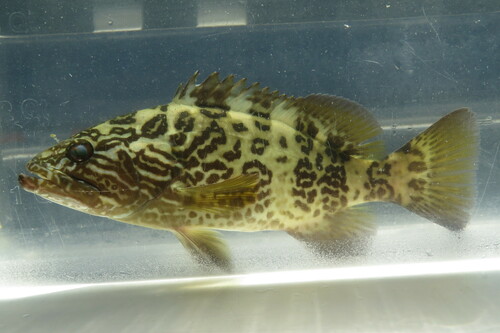
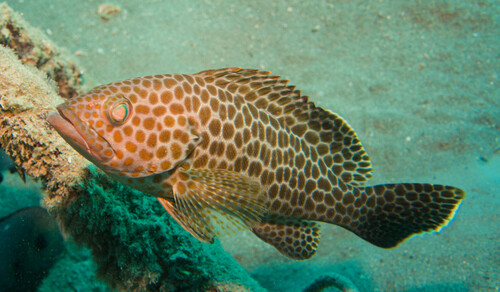
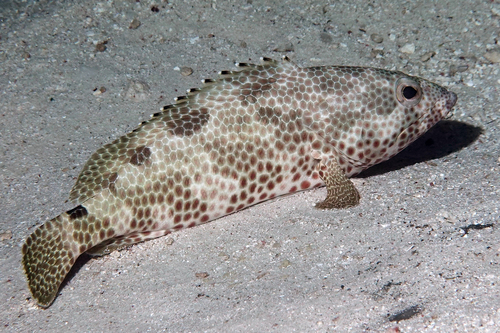
The head and body of this fish are pale, and are mostly covered in numerous dark olive-brown to reddish-brown polygonal spots.
These spots are set closely together, with pale spaces between them that form a reticulated pattern.
Saddle Blotches
There are four dark saddle-shaped blotches: three along the base of the dorsal fin, and one on the caudal peduncle.
Pectoral Fin Color
The outer portion of the pectoral fins is yellowish-green.
Maximum Size
This species reaches a maximum total length of 35 centimetres (14 in).
Overall Distribution Range
Epinephelus spilotoceps is widely distributed across the Indo-West-Pacific.
Western Indian Ocean Distribution
It occurs along the eastern coast of Africa from Kenya and Zanzibar to Ponta Zavora, Mozambique, and also lives on the Indian Ocean islands of Mauritius, Comoros, Seychelles, Chagos, Maldives, Laccadives, Andaman Islands, and Nicobar Islands.
Eastern Distribution Limit
Its range extends eastwards into the Malayan Archipelago, reaching as far east as Micronesia, the Line Islands, and the Cook Islands.
Southern Distribution Limit
It ranges south to the Great Barrier Reef and the northwestern coast of Australia.
Distribution Absences
It is not found in the South China Sea or the Java Sea.
Habitat Preference
With the exception of its coastal distribution off Eastern Africa, this species prefers habitats around islands.
Coral Reef Habitat
Epinephelus spilotoceps lives in shallow coral reefs, mainly occurring on patch reefs within lagoons, the upper slopes of channels that cut through reefs, and outer reef margins.
Maldives Microhabitat
It has been recorded on rubble patches in the Maldives, where it is mostly found near the edges of complex coral formations and stays close to these structures, avoiding open areas.
Captive Diet
In captivity, this species feeds on crustaceans and fish.