About Morelia spilota (Lacépède, 1804)
Common Name and Taxon Classification
Morelia spilota, commonly known as the carpet python, is a large python species.
Adult Length Range
Adult individuals reach a total length of 2 to 4 meters (6.6 to 13.1 feet) and can weigh up to 15 kilograms (33 pounds). The average adult length is roughly 2 meters (6.6 feet).
Largest Subspecies Size
Of its recognized subspecies, M. s. mcdowelli is the largest, regularly growing to 2.7 to 3.0 meters (8.9 to 9.8 feet) in length. One 3-year-old captive male M. s. mcdowelli measured in Ireland was recorded to exceed 396 centimeters (12.99 feet).
Smallest Subspecies Size
The smallest subspecies is M. s. variegata, which typically reaches 120 to 180 centimeters (3.9 to 5.9 feet) in length.
Sexual Size Dimorphism
On average, males are smaller than females; in some regions, females can be up to four times heavier than males.
Head and Sensory Features
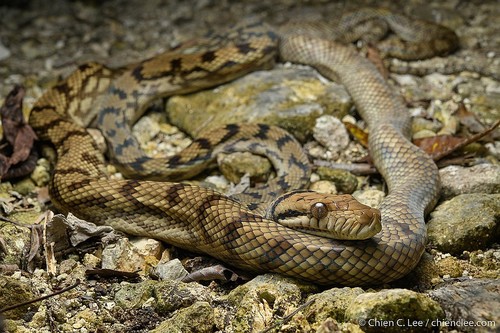
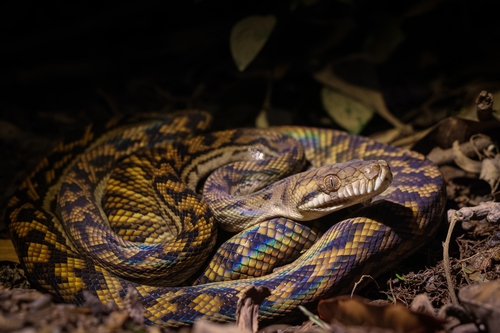
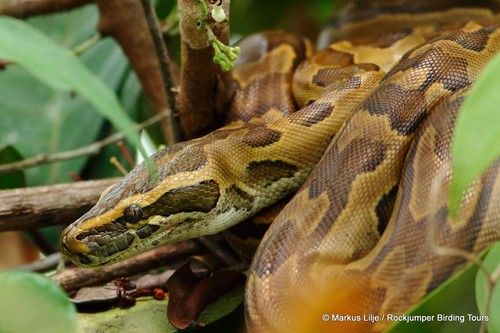
This species has a triangular head marked by a distinct row of thermoreceptive pits along its lips.
Base Coloration
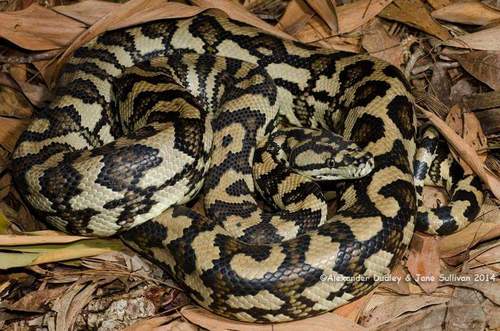
Its coloration is highly variable, ranging from olive to black base tones paired with white, cream, or gold markings.
Body Patterning
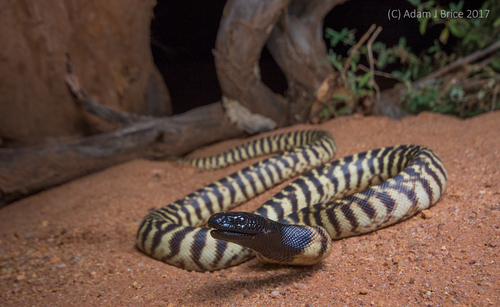
Its patterning may form rough diamond shapes, or consist of intricate light and dark banding over a grey or brown background.
Australian Distribution
This species is distributed across mainland Australia, excluding the arid interior and western regions; it is also widely distributed across the forested areas of Southwest Australia.
Non-Australian Distribution
It also occurs in Indonesia (southern Western New Guinea, in Merauke Regency), Papua New Guinea (southern Western Province, and the Port Moresby area of Central Province), and on Yule Island.
Type Locality
The species' originally recorded type locality is given as "Nouvelle-Hollande", which refers to Australia.
Subspecies Habitat Associations
Morelia spilota occupies a very wide range of habitats: it can be found in the rainforests of northeastern Queensland (occupied by the subspecies M. s. cheynei), the River Red Gum/Riverbox woodlands along the Murray and Darling Rivers (occupied by M. s. metcalfei), the arid, treeless islands of the Nuyts Archipelago off the west coast of South Australia (occupied by M. s. imbricata), and temperate grasslands that experience hot, dry conditions.
Human Proximity Habitat
It is also known to live in areas that receive annual snowfall, and is often found near human settlements, where it feeds on rats and other vermin.
Reproductive Strategy
This species is oviparous; after mating, females lay clutches of 10 to 50 eggs.
Maternal Egg Care
Females will coil around the clutch to protect the eggs and keep them warm, generating heat through muscular contractions. This form of maternal care, which is typical for pythons, ends once the eggs hatch and hatchlings emerge.