About Morelia viridis (Schlegel, 1872)
Body and Tail Structure
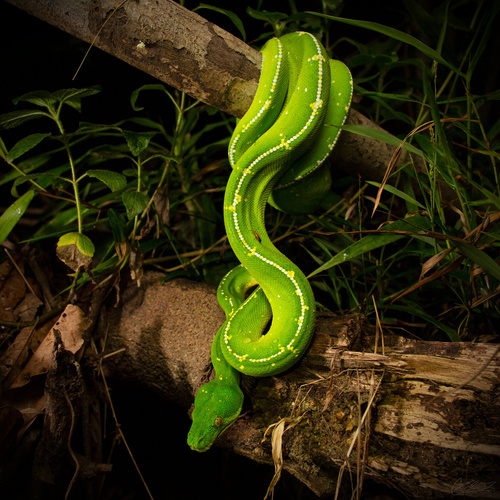
Green tree pythons (Morelia viridis) have relatively slim bodies, with long tails that make up roughly 14% of their total body length. Their heads are large and clearly separated from the neck, while their snouts are large and angular. Their bodies are triangular in cross-section, with a visible spine.
Adult Length
Most adults of this species reach a total length (including the tail) of 150–180 cm (4.9–5.9 ft), though large females may grow to 200 cm (6.6 ft). Adult size also varies by the region the snake originates from.
Body Weight
Body weight is strongly dependent on an individual's nutritional status. Males typically weigh between 1,100 and 1,400 g (2.4–3.1 lb), while females can reach up to 1,600 g (3.5 lb). Wild specimens are usually considerably lighter than these weights.
Sexual Size Dimorphism
Especially large individuals, which can weigh up to 2,200 g (4.9 lb), are always female. Like most snakes, female green tree pythons are slightly larger and heavier than males.
Geographic Range
This species occurs in Eastern Indonesia (Misool, Salawati, Aru Islands, Schouten Islands, most of Western New Guinea), Papua New Guinea (including nearby islands from sea level up to 1,800 m elevation, as well as Normanby Island and the d'Entrecasteaux Islands), and Australia, along the east coast of Queensland's Cape York Peninsula. Its type locality is given as "Aroe-eilanden", the Aru Islands of Indonesia.
Sympatric Species
Morelia viridis is sympatric with Morelia spilota, and the two species often compete for the same ecological niche.
Habitat Preferences
The preferred natural habitat of M. viridis is within or near rainforests. The species is primarily arboreal, living in trees, shrubs, and bushes, and is occasionally seen on the ground.
Reproduction
Morelia viridis is oviparous, producing clutches of one to 25 viable eggs. Breeding of this species has never been documented in the wild, but in captivity, females incubate and protect their eggs.
Juvenile Coloration
Hatchlings are lemon-yellow with broken stripes and spots of purple and brown; they may also be golden or orange-red.
Ontogenetic Color Change
For yellow juvenile individuals at Iron Range National Park, Australia, the shift to adult coloration took place over 5–10 days when the snakes were 58–60 cm (23–23.5 in) long, at approximately one year of age. Color change in wild red juvenile green tree pythons has not been observed.