About Mixophyes australis Bertozzi & Guzinski, 2023
Nomenclature
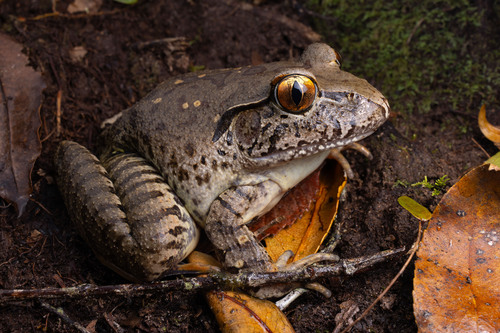
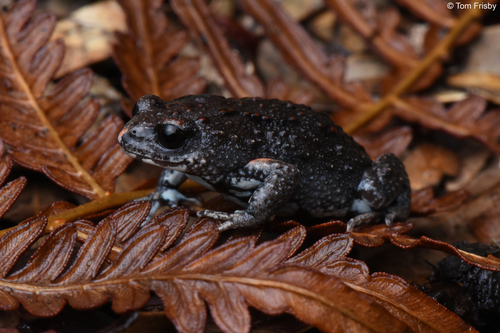
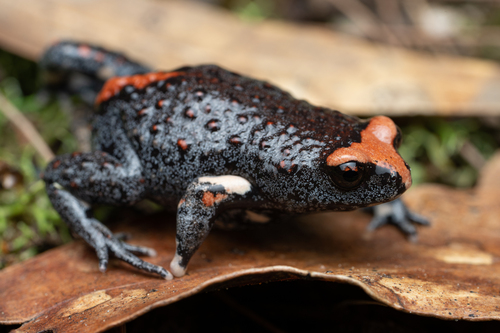
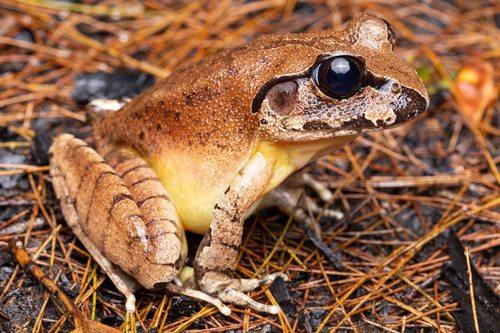
The southern stuttering frog, scientifically named Mixophyes australis Bertozzi & Guzinski, 2023, is a large frog species endemic to southeastern Australia.
Geographic Range
Its current or historical range extends from Carrai National Park in mid-eastern New South Wales south to East Gippsland in Victoria.
Habitat
This species lives in temperate and subtropical rainforests, wet sclerophyll forests, and moist gullies within dry forests.
Taxonomic History
For a long time, southern populations of this frog were considered part of the stuttering frog M. balbus, and it was only recognized as a separate new species in 2023.
Species Delimitation
That year, a phylogenetic study found that it is deeply genetically divergent from M. balbus, leading to its formal description as a new species.
Distribution Boundary
The distribution of the northern M. balbus (northern stuttering frog) and southern M. australis (southern stuttering frog) is divided by the Macleay River.
Habitat Breadth Comparison
Unlike M. balbus, which is a specialist restricted to high-altitude areas, M. australis has recorded populations in both upland and lowland habitats.
IUCN Red List Status
This species has been lost from two-thirds of its original range, so it qualifies as Endangered on the IUCN Red List.
Population Trends
Populations located south of Sydney have experienced dramatic declines, and all Victorian populations are believed to be extinct, while northern populations of M. australis are thought to remain stable.