About Mirabilis multiflora (Torr.) A.Gray
Scientific Classification and Growth Form
Mirabilis multiflora (Torr.) A.Gray is a perennial herb that grows upright, reaching a maximum height of around 80 centimeters (31 inches).
Leaf Arrangement
Its leaves are arranged oppositely on spreading stem branches.
Leaf Characteristics
Each fleshy leaf has an oval or rounded blade up to 12 centimeters (4.7 inches) long, and may be hairless or sparsely hairy.
Winter Dormancy
In winter, the above-ground portion of the plant dies back to the ground, with its stem breaking off at ground level and leaving no visible trace of the root's location; the plant reemerges in mid winter or spring.
Drought Response
It also dies back to the ground during periods of extreme drought.
Flower Placement
Flowers grow in the leaf axils of the upper branches.
Inflorescence Structure
Typically, six flowers bloom within a bell-shaped involucre made of five partly fused bracts.
Flower Morphology
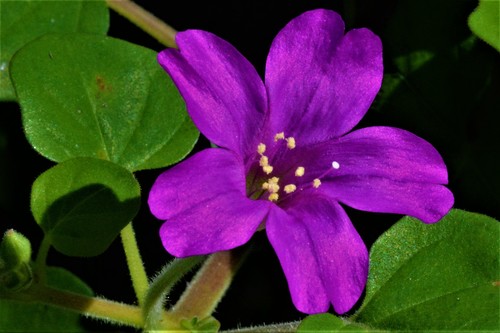
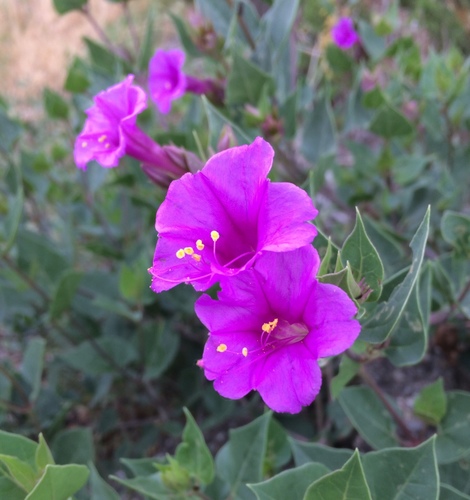
Each five-lobed, funnel-shaped flower is 4 to 6 centimeters (1.6 to 2.4 inches) wide and magenta in color.
Pollination
Reproduction in M. multiflora depends on hawkmoths for pollination; the two primary pollinators are the hawkmoths Hyles lineata and Manduca quinquemaculata.
Zuni Culinary Use
Among the Zuni people, powdered root of this plant is mixed with flour to make bread, which is used to decrease appetite.
Root Infusion for Hunger
An infusion made from the root is taken internally and rubbed onto the abdomen of hungry adults and children.
Root Infusion for Overeating
An infusion of the powdered root is taken by adults or children after overeating.