About Mimosa pudica L.
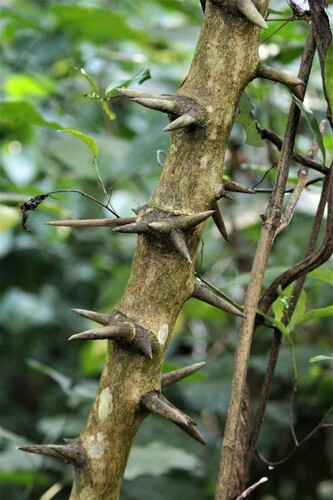
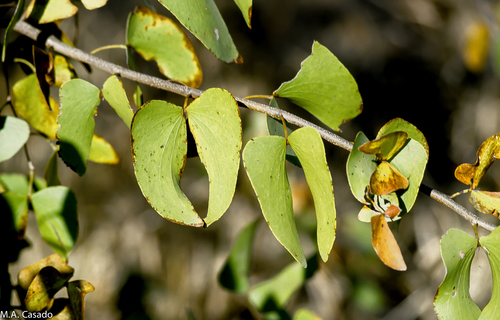
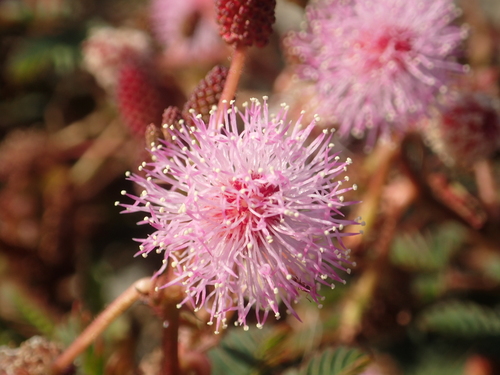
Mimosa pudica L. has stems that are erect when young, but become creeping or trailing with age; they can hang very low and become floppy. Stems are slender, branching, and sparsely to densely prickly, reaching a length of 1.5 m (5 ft), while the plant's typical erect height is around 30 cm (~1 ft). Its leaves are bipinnately compound, with one or two pairs of pinnae, and 10–26 leaflets per pinna. The petioles are also prickly. Stalked pale pink or purple flower heads grow from leaf axils starting in mid-summer, producing more flowers as the plant ages. Individual flowers live less than a day, and typically die completely by the next day. The flowers are very brittle and soft. The flower heads are globose to ovoid, 8–10 mm (0.3–0.4 in) in diameter, excluding the stamens. On close inspection, floret petals are red in their upper section, and their filaments are pink to lavender. Pollens are circular, approximately 8 microns in diameter. The fruit forms in clusters of two to eight pods, each 1–2 cm (0.4–0.8 in) long, with prickly margins. The pods break into two to five segments, and contain pale brown seeds about 2.5 mm (0.1 in) long. Flowers are pollinated by both insects and wind. Seeds have hard seed coats that restrict germination, and make osmotic pressure and soil acidity less significant barriers to germination. High temperatures are the main stimulus that breaks seed dormancy. The roots of Mimosa pudica produce carbon disulfide, which prevents the growth of certain pathogenic and mycorrhizal fungi in the plant's rhizosphere. This allows the formation of root nodules that contain endosymbiotic diazotrophs, which fix atmospheric nitrogen and convert it into a form the plant can use. Mimosa pudica is a tetraploid, with 2n = 52. This species is native to tropical Americas. It is also found across many Asian countries, including Singapore, Bangladesh, Thailand, India, Nepal, Indonesia, Taiwan, Malaysia, the Philippines, Vietnam, Cambodia, Laos, Japan, and Sri Lanka. It has been introduced to many other regions, and is classified as an invasive species in Tanzania, South and Southeast Asia, and many Pacific islands. It is considered invasive in parts of Australia; it is a declared weed in the Northern Territory and Western Australia, although it is not naturalized there, and control is recommended in Queensland. It has also been introduced to Uganda, Ghana, Nigeria, Seychelles, Mauritius, and East Asia, but is not considered invasive in these locations. In the United States, it grows in Louisiana, Florida, Hawaii, Tennessee, Virginia, Maryland, Puerto Rico, Texas, Alabama, Arkansas, Mississippi, North Carolina, Georgia, and the territories of Guam and the Virgin Islands. In cultivation, this plant is most often grown as a short-lived indoor perennial, but is also used as a groundcover. Propagation is generally done by seed, with germination occurring in 2-3 weeks. Mimosa pudica grows best in nutrient-poor soil that allows good water drainage, but it can also grow in scalped and eroded subsoils. Disrupted soil is typically required for M. pudica to become established in an area. The plant is shade intolerant and frost-sensitive, so it cannot tolerate low light levels or cold temperatures. It does not compete for resources with larger foliage or forest canopy undergrowth. In temperate zones, it must be grown under protection when temperatures fall below 13 °C (55 °F).