About Parochetus africanus Polhill
Growth Habit
Parochetus communis is a prostrate herb that grows 10–20 centimetres (3.9–7.9 in) tall.
Leaf Structure
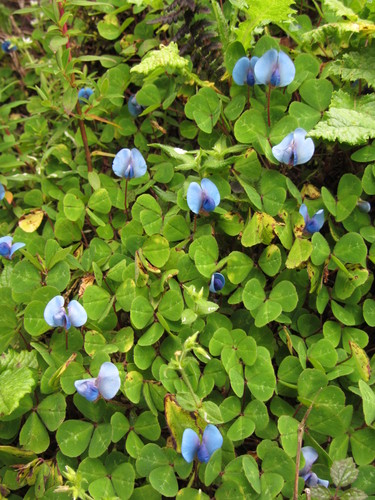
Its leaves are trifoliate (three-parted, similar to clover leaves). Each individual leaflet measures 8–20 mm (0.3–0.8 in) in both length and width, and can exceptionally reach up to 40 mm or 1.6 in.
Leaflet Morphology
Leaflets are wedge-shaped (cuneate) at the base, notched at the tip, and have margins that are either smooth or bear minute teeth. The stipules at the base of each leaf stalk are 4–5 mm (0.16–0.20 in) long and entire, meaning untoothed and undivided.
Flower Stalks
Flowers of P. communis are borne singly or in clusters of up to three flowers on stalks that are typically 8–15 cm (3.1–5.9 in) long, with a full range of 1.5–25 cm (0.6–9.8 in) long.
Flower Coloration
Most flowers are blue, but occasional individuals have white or purple flowers.
Standard Petal
The large upper petal, called the standard, is 12–20 mm (0.5–0.8 in) long, notched at the tip, and narrowed at the base.
Lateral and Keel Petals
The lateral petals, called wings, measure around 13 mm (0.5 in) long, while the keel is 20–25 mm (0.8–1.0 in) long and 3–4 mm (0.1–0.2 in) wide.
Pod Characteristics
Seeds of P. communis develop inside pods. Each pod is 15–25 mm (0.6–1.0 in) long and 4–5 mm (0.16–0.20 in) wide, and holds 8–12 seeds.
Seed Morphology
Each seed is around 2 mm (0.08 in) long, slightly kidney-shaped, and somewhat narrower than it is long.
Native Range
Parochetus communis is native to the Himalaya, other Asian mountain systems extending south to Java, and Afrotropical mountains.
African Distribution
In Africa, it occurs in Burundi, central Ethiopia, eastern Democratic Republic of the Congo, Kenya, Rwanda, Tanzania, and western Uganda.
General Habitat
It grows in damp, shady locations including forest floors and the banks of streams and rivers, at altitudes of 1,500–2,000 metres (4,900–6,600 ft).
Chinese Altitude Range
In China, it grows at altitudes of 1,800–3,000 m (5,900–9,800 ft).
Introduced Range
This species has been introduced to New Zealand, where it was first recorded in 1944.
Conservation Status
Due to its wide distribution and the lack of identified threats to the species, Parochetus communis is classified as Least Concern on the IUCN Red List.