About Microhierax melanoleucos (Blyth, 1843)
Species Introduction
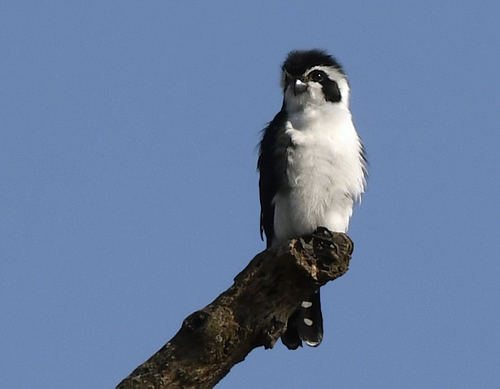
The pied falconet, Microhierax melanoleucos, is a small black-and-white raptor.
Size and Weight
It measures 7 to 7.5 inches in length and weighs 55 to 75 grams, and is larger than other members of the genus Microhierax.
Facial Markings
Its face is white, with a prominent black patch covering the eyes that extends to the ear coverts.
Upperbody Coloration
All upper parts, including the crown, are completely black.
Flight Feather Characteristics
The primary flight feathers are black with white wing bars.
Tail Appearance
Its long tail is black on the upper side, and black with white bars when viewed from below.
Sexual Dimorphism and Juvenile Traits
This species has no sexual dimorphism, and juvenile individuals strongly resemble adult males.
Genus Size Status
All five species in the genus Microhierax are the smallest members of the order Falconiformes.
Genus Morphology Comparison
While they have a distinct morphology compared to other birds of prey, they are quite similar in form to one another within the genus.
Genus Distribution Pattern
All Microhierax species are allopatric, except M. fringillarius and M. latifrons.
Genus Ecological Roles
Morphological similarities across the genus mean they most likely fill very similar ecological roles in their respective habitats.
Species Distinguishing Features
M. melanoleucos can be distinguished from other members of the genus by its white thighs and the complete absence of chestnut coloration.
Similar Species Distinction
It is sometimes mistaken for the ashy woodswallow (Artamus fuscus), but the pied falconet has much blacker upper parts than the grey-ash plumage of the ashy woodswallow.
Geographic Range
The pied falconet’s range extends from north-eastern India through eastern China to Southeast Asia.
Habitat Preferences
It inhabits deciduous forest edges and clearings in wooded foothills, and favors clearings such as old cultivated lands with banks and streams.
Perching and Hunting Behavior
It typically perches on tree tops, and occasionally flies out to catch prey.
Migratory Status
It is a non-migratory resident species that stays in the same area for most of the year.
Breeding Season Timing
The breeding season of the pied falconet runs from March to May.
Early Breeding Courtship
Early in the breeding season, males signal mating interest to females by gathering and presenting leaves to them: the male flies off, collects a leaf, then returns to the perched female to offer it.
Pre-Copulation Display
Later in the breeding season, usually before copulation, males bob rapidly up and down in front of females while calling frantically.
Copulation Timing
Copulation occurs after this display.
Nest Site and Lining
These small raptors build their nests in old cavities originally excavated by barbets or woodpeckers, and line their nesting cavities with a bed of leaves or grass.
Alternate Nest Lining
There are also records of nesting cavities filled with insect remains instead of foliage.
Clutch Characteristics
Females lay three to four white eggs.
Congener Behavioral Similarities
Pied falconets share many courtship and mating behaviors with the collared falconet (Microhierax caerulescens).
Leaf Presenting Documentation
Leaf-presenting courtship behavior was first documented in the collared falconet.
Cooperative Breeding in Genus
The collared falconet is known to practice cooperative breeding, and this behavior is also suspected for the black-thighed falconet (Microhierax fringillarius) and other Microhierax species.
Cooperative Breeding Evidence
Pied falconets are often observed in groups of 5 or 6, which suggests they may also breed cooperatively.