About Caracara plancus (J.F.Miller, 1777)
Scientific Nomenclature
The crested caracara, scientifically named Caracara plancus (J.F.Miller, 1777), has a total length of 50–65 cm (20–26 in), a wingspan of 120–132 cm (47–52 in), and a weight of 0.9–1.6 kg (2.0–3.5 lb).
Size Regional Variation
The average weight of seven individuals from Tierra del Fuego is 1,348 g (2.972 lb). As predicted by Bergmann's rule, individuals from the colder southern portion of the species' range are larger on average than those from tropical regions, and these southern individuals are the largest type of caracara.
Relative Species Size
By mean body mass, the crested caracara is the second-largest falcon species in the world, outranked only by the gyrfalcon.
Adult Plumage Dark Regions
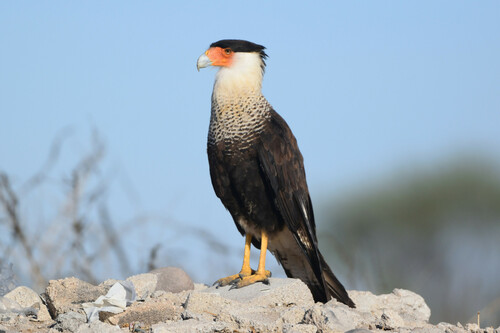
For adult plumage, the cap, belly, thighs, most of the wings, and tail tip are dark brownish. The auriculars (feathers surrounding the ear), throat, and nape are whitish-buff.
Adult Plumage Barred Regions
The chest, neck, mantle, back, upper tail coverts, crissum (the undertail coverts surrounding the cloaca), and basal part of the tail are whitish-buff with dark brownish barring.
Flight Plumage Feature
In flight, the outer primaries have a large, conspicuous whitish-buff patch called a 'window', a feature shared with several other caracara species.
Adult Soft Parts
Adults have yellow legs, and their bare facial skin and cere range in color from deep yellow to reddish-orange; facial color can change based on the bird's mood.
Juvenile Appearance
Juveniles look similar to adults, but are paler, have streaking on the chest, neck, and back, grey legs, and whitish facial skin and cere that later turn pinkish-purple.
Core Distribution Range
The crested caracara's distribution ranges from Tierra del Fuego in the southernmost part of South America north to the southern United States, Mexico, and Central America. There is an isolated population of the species on the Falkland Islands.
Avoided Habitats
It avoids Andean highlands and dense humid forests such as the Amazon rainforest, where it is mostly limited to relatively open areas along major rivers.
Preferred Habitats
Outside of these avoided areas, it lives in almost any open or semi-open habitat, and is often found near human settlements.
US West Coast Sightings
There have been reported sightings of crested caracara as far north as San Francisco, California, and in 2012, a sighting was recorded near Crescent City, California.
Canada Sightings
It is thought that some crested caracaras may live in Nova Scotia, with multiple sightings recorded there throughout the 2010s.
Texas Population Status
The species has become more common in central and northern Texas recently, and is generally common in south Texas and in areas south of the US border.
Caribbean Distribution
It can also be found, and nests, in the Southern Caribbean, including Aruba, Curaçao and Bonaire, as well as in Mexico and Central America.