About Falco cherrug J.E.Gray, 1834
Taxonomic Classification
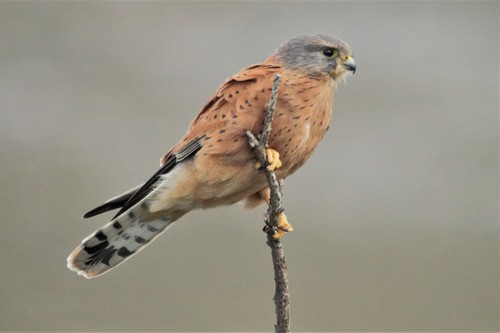
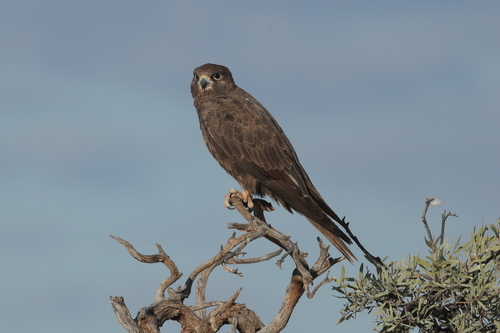
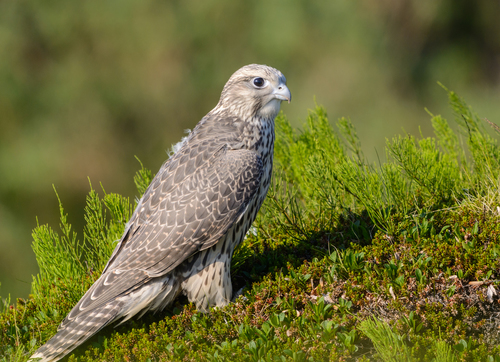
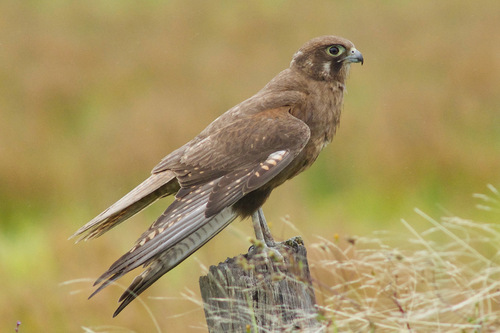
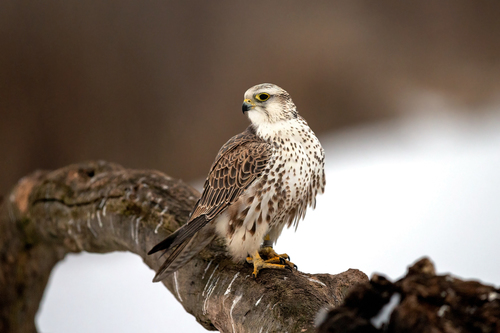
The saker falcon, scientifically Falco cherrug J.E.Gray, 1834, is a large hierofalcon.
Size Comparisons
It is larger than the lanner falcon and almost as large as the gyrfalcon, with a body length of 45–57 cm (18–22 in), a wingspan of 97–126 cm (38–50 in).
Weight
Males weigh 730–990 g (26–35 oz), while females weigh 970–1,300 g (34–46 oz).
Morphological Similarities
It resembles a larger, browner gyrfalcon, and is larger and more heavily built than the closely related lanner falcon.
Plumage Variability
Saker falcons typically have variable plumage.
Adult Plumage
Males and females are identical in plumage, differing only in size.
Juvenile Plumage
Young birds also share similar plumage aside from size, though they tend to be darker with more heavy streaking.
Vocalizations
The species' call is a sharp kiy-ee, or a repeated kyak-kyak-kyak.
Habitat
In terms of ecology, the saker falcon is a raptor that inhabits open grasslands, preferring areas with some trees or cliffs.
Hunting Method
It often hunts via horizontal pursuit, rather than the stoop from height used by peregrine falcons.
Diet
It feeds mainly on rodents and birds; in Europe, ground squirrels and feral pigeons are its most common prey.
Nest Construction Behavior
This species usually does not build its own nest.
Egg Laying
Instead, it lays a clutch of 3–6 eggs in an old stick nest in a tree that was previously used by other large birds such as storks, ravens, or buzzards.
Alternative Nesting Sites
It also frequently nests directly on cliffs.
Nest Commensals
Saker falcon nests support a species-rich community of commensal insects.
Falconry Use History
For use in falconry, the saker falcon has been used in the practice for thousands of years, and is highly regarded in falconry, similar to its very close relative the gyrfalcon.
Falconry Hunting Utility
Swift and powerful, it is effective for hunting medium-sized to large-sized game bird species.
Hunting Speed
Saker falcons can reach speeds of 120 to 150 km/h when hunting, and suddenly swoop down on their prey.
Hybridization Use
Saker falcons can be hybridized with peregrine falcons to produce falcons used for controlling larger bird species considered pests.