About Melanerpes lewis (G.R.Gray, 1849)
Taxonomic Classification
Lewis's woodpecker (Melanerpes lewis) is one of the largest species of American woodpeckers, and is among the three largest Melanerpes woodpeckers in the world, similar in size to the white woodpecker and the Jamaican woodpecker.
Size Measurements
This species measures 10–11 inches (25–28 cm) in length; more precise recorded measurements are 10.2–11.0 in (26–28 cm) in length, 3.1–4.9 oz (88–139 g) in weight, and 19.3–20.5 in (49–52 cm) in wingspan.
Plumage Characteristics
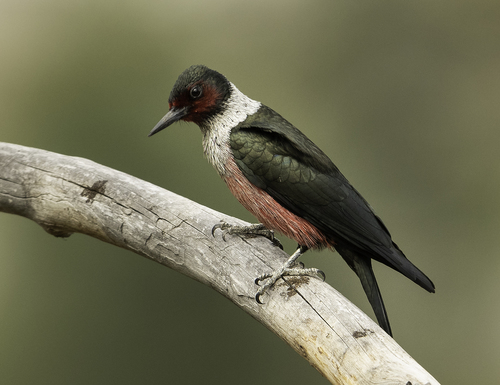
Lewis's woodpecker has a primarily blackish-green body, a reddish breast, and a black rump. It has a gray collar and gray upper breast, a pinkish belly, a red face, and much broader wings than other woodpeckers.
Flight Traits
Its flight is much slower than that of other woodpeckers, with slow, even wingbeats similar to those of a crow.
Vocalizations
Its calls are harsher than the calls of other woodpeckers, and it can use a repertoire of several different phrases.
Core Habitat Range
Lewis's woodpecker is locally common in the northwestern United States. It mainly inhabits open pine woodlands and other areas with scattered trees and snags.
Perching Behavior
Unlike other American woodpeckers, it prefers to perch out in the open rather than in dense tree cover.
Migration Patterns
The species has a nomadic lifestyle and feeding habits, so its migration patterns are not well understood.
Geographic Distribution
Its core range extends across western to central United States. In winter, it can be found as far south as Southern California and the U.S.-Mexico border; in summer, it can be found as far north as Canada. It has been observed in five Midwestern U.S. states: South Dakota, Michigan, Illinois, Minnesota, and Wisconsin, as well as in California, Oregon, Washington, Idaho, Montana, Nevada, Colorado, and Utah.