About Dinopium javanense (Ljungh, 1797)
Sexual Dimorphism in Crest Color
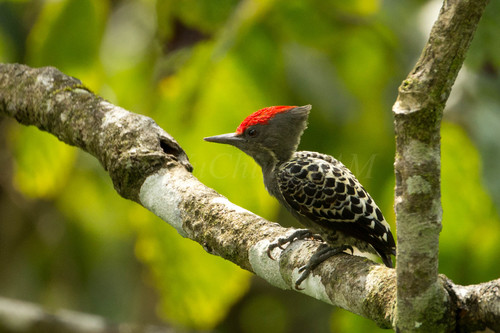
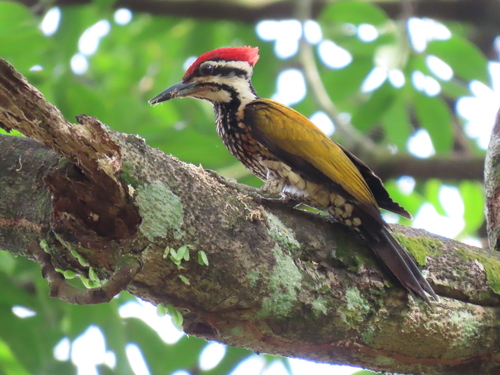
Dinopium javanense, the common flameback, shows clear sexual dimorphism in crest color: males have a bright red crest, while females have a black crest with white streaks.
Shared Plumage Patterns
Both sexes share the same pattern of a white supercilium, white cheek stripe, and white throat area, all separated by black stripes, along with a black and white spotted underside.
Similar Species Distinction (Visual Traits)
This species can be told apart from similar golden-backed woodpeckers: it differs from the greater flameback (Chrysocolaptes guttacristatus) by its smaller bill and black nape, and it differs from the black-rumped flameback by its red rump and white throat.
Vocalization and Species Identification
Its loud, high-pitched call, which sounds like a series of rattling "kow-kowp" notes, is extremely similar to the call of the greater flameback, and this call is the most reliable way to distinguish the common flameback from the nearly identical Himalayan flameback.
General Behavior
Common flamebacks are shy, secretive birds that rarely occur in urban areas.
Habitat Types
They occupy a wide range of habitats including moist open forests, scrublands, and mangroves.
Elevation Range and Habitat Preference
While they generally favor lowland areas, they can be found at elevations up to 1700 meters above sea level in India, where they prefer pine forest habitats.
Geographic Distribution
Their distribution spans Southeast Asia, from the Western Ghats of India across the Indochinese peninsula to several of the Greater Sunda Islands.
Reproduction Research Status
There is limited available information about the reproduction and mating behavior of the common flameback.
Courtship Behavior Accounts
Some sources report that no courtship displays occur during copulation, with only the male raising his crest when mounting the female. Other sources describe a short mating display that includes both sexes raising their crests, bowing movements, head swinging, and males providing courtship feeding to females.
Nesting and Clutch Size
They nest in holes excavated in fruit trees, coconut palms, or stumps of these tree types, and their clutch size is 2 or 3 eggs.