About Megadyptes antipodes (Hombron & Jacquinot, 1841)
Nominate Subspecies Identification
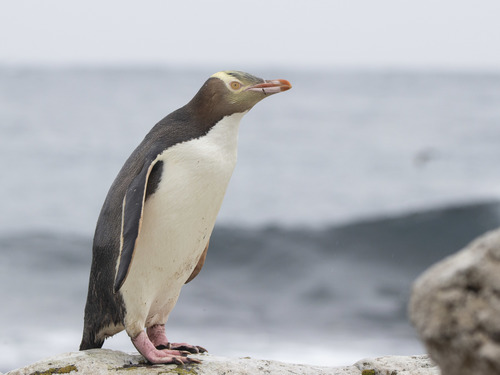
The nominate subspecies of Megadyptes antipodes, commonly called the yellow-eyed penguin, can be most easily recognized by a band of pale yellow feathers that surrounds its eyes and circles the back of its head. Its forehead, crown, and the sides of its face are slate grey with flecks of golden yellow.
Adult Head and Body Coloration
The species has yellow eyes, light brown foreneck and head sides, and slate blue-black back and tail. The chest, stomach, thighs, and underside of the flippers are white.
Juvenile Appearance
Juvenile yellow-eyed penguins have a greyer head, and lack the yellow band around the eyes.
Size Rank
This penguin is the largest living penguin that breeds on the mainland of New Zealand, and ranks as the fourth or fifth heaviest living penguin species by body mass.
Standard Body Measurements
It measures 62–79 centimetres (24–31 in) in height, and weighs 3–8.5 kilograms (6.6–18.7 lb).
Moult-Related Weight Fluctuation
Body weight changes throughout the year; penguins reach their heaviest weight just before moulting, and may lose 3–4 kilograms of weight during the moulting process.
Sex-Based Weight Difference
On average, males are somewhat heavier than females: males average around 5.53 kg (12.2 lb), while females average 5.13 kg (11.3 lb).
Lifespan Characteristics
Yellow-eyed penguins can be long-lived, with some individuals reaching 20 years of age. Males generally have longer lifespans than females, resulting in a 2:1 sex ratio for individuals around 10–12 years old.
Vocalization Behavior
The species is mostly silent, and only produces a shrill, bray-like call at nesting and breeding sites.
Previous Historical Range Assumption
Until recently, researchers assumed the nominate subspecies was widespread and abundant in what is now New Zealand before the arrival of Polynesian settlers.
Updated Historical Range Findings
Genetic analysis has since shown that its range only expanded to include mainland New Zealand within the past 200 years. Yellow-eyed penguins expanded out of the subantarctic region to replace the extinct endemic New Zealand Waitaha penguin (M. waitaha), which died out between approximately 1300 and 1500, soon after Polynesian settlers arrived in New Zealand.
Extinct Chatham Islands Subspecies
A dwarf extinct subspecies of Megadyptes antipodes, M. a. richdalei, formerly existed on the Chatham Islands. Modern yellow-eyed penguins do not breed on the Chatham Islands.
Modern Population Structure
Today, the species has two distinct separate populations.
Northern Population Range
The northern, or mainland, population extends along the southeast coast of New Zealand's South Island, down to Stewart Island / Rakiura and Codfish Island / Whenua Hou. It has four main breeding areas: Banks Peninsula, North Otago, Otago Peninsula, and the Catlins.
Southern Population Range
The southern population occurs on the subantarctic Auckland Islands and Campbell Island / Motu Ihupuku.
Population Isolation Mechanism
There is very little gene flow between the northern and southern populations, as the large expanse of ocean between the South Island and the subantarctic region, along with the subtropical convergence, acts as a natural barrier.
Enderby Island Breeding Population
Monitoring conducted between 2012 and 2017 found that there are an average of 577 breeding pairs per year on Enderby Island (part of the Auckland Islands), which makes up 37-49% of the species' total global breeding population.