About Eudyptes sclateri Buller, 1888
Nomenclature and Taxonomic Identity
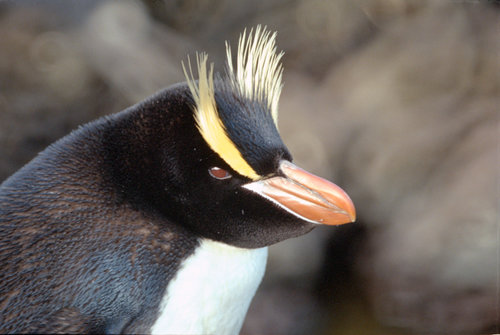
Erect-crested penguin, scientifically named Eudyptes sclateri Buller, 1888, is a small-to-medium-sized yellow-crested black-and-white penguin.
Standard Length and Weight
It measures 50–70 cm (20–28 in) in length and weighs 2.5–6 kg (5.5–13.2 lb), with males slightly larger than females and having a larger bill, a trait shared with most crested penguins.
Plumage and Crest Characteristics
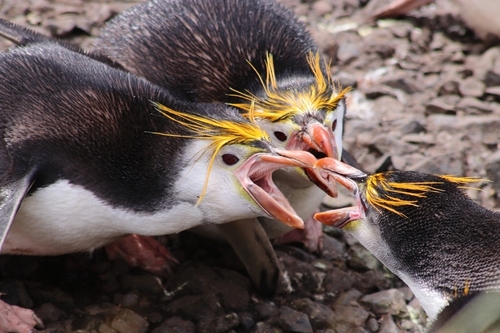
Its upperparts range from bluish-black to jet black, while its underparts are white; it has a broad, bright yellow eyebrow stripe that extends over the eye to form a short, erect crest.
Species Size Rank
With a mean body mass of 6.38 kg (14.1 lb) for males (sample size 22) and 5.4 kg (12 lb) for females (sample size 22), it is the largest crested penguin species and the fourth heaviest living penguin, with an average weight nearly matching that of the gentoo penguin.
Research Status
The biology of this species is poorly studied, and little new information about it has emerged over the past decades.
Recent Research Focus
The only recent study of the species, carried out on the Antipodes Islands, focused on elements of mate choice.
Research Barriers
Research on Eudyptes sclateri is limited by difficult logistics and restrictive permitting from the New Zealand Department of Conservation.
Presumed Diet
It is presumed to feed on small fish, krill, and squid, similar to other crested penguin species.
Etymology
Its scientific binomial name honors British zoologist Philip Lutley Sclater.
Confirmed Breeding Range
Erect-crested penguins breed on the Bounty and Antipodes Islands.
Historical Breeding Records
Small breeding populations have previously been recorded from Campbell Island and the Auckland Islands, and a breeding pair was documented on the New Zealand mainland's Otago Peninsula in the 1940s.
At-Sea Periods
The species spends long periods at sea during the pre-moult period (February to March) as well as throughout the winter months (March to August).
Vagrant Records
Individual penguins have been found as far from breeding grounds as the Falkland Islands, and it also occurs as a vagrant in Argentina, Antarctica, and Australia.
Nesting Habitat
Erect-crested penguins nest in large colonies on rocky terrain.
Antipodes Islands Colony Composition
On the Antipodes Islands, they breed in single-species colonies, or sometimes alongside Southern Rockhopper penguins.
Bounty Islands Colony Composition
On the Bounty Islands, they breed in large mixed colonies with Salvin's albatross.
Egg Laying Period
Erect-crested penguins lay clutches of two eggs between September and late January.
Egg Size Dimorphism
The first egg laid is typically 25% to 70% smaller than the second egg.
Incubation Strategy
This extreme difference in egg size is linked to asynchronous incubation habits, where the larger egg receives more space and higher priority than the smaller egg.