About Spheniscus demersus (Linnaeus, 1758)
This species, scientifically named Spheniscus demersus (Linnaeus, 1758), is commonly known as the African penguin, sometimes nicknamed the "jackass penguin" from its loud braying calls.
Adult Size
Adult African penguins measure 60–70 cm (24–28 in) in height, and weigh between 2.2–3.5 kg (4.9–7.7 lb). Their beaks are usually 4.8–6.5 cm (1.9–2.6 in) long.
Sexual Dimorphism
This species shows slight sexual dimorphism: males are slightly larger than females, and have longer beaks.
Unique Chest Markings
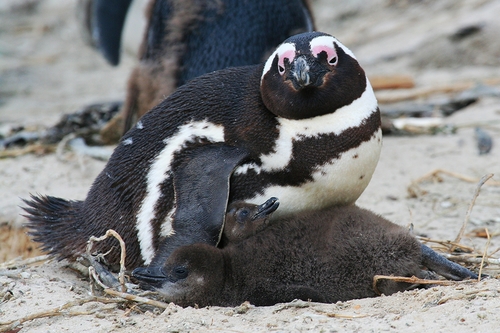
Each African penguin has a unique pattern of black stripe and black spots on its chest, just like human fingerprints.
Body Pattern Features
They have a distinct thick black upside-down horseshoe-shaped band on the body, black feet, and individual black spots that vary in size and shape between individuals.
Temperature Regulation Adaptations
They have sweat glands above their eyes that cool their blood; as temperature rises, increased blood flow makes these glands turn pinker.
Juvenile Plumage
Juvenile African penguins do not have the clear, bold markings of adults. Instead, their upperparts are dark and range from greyish-blue to brown, while their pale underparts have neither spots nor a band.
Beak Comparison
The African penguin's beak is more pointed than that of the Humboldt penguin.
Countershading Camouflage
The species' coloration is a type of protective camouflage called countershading: when viewed by predators from underwater, the white undersides are hard to spot, and when viewed from above water, the black backs blend in with the surrounding water.
Related Penguin Species
African penguins are related to and resemble Humboldt, Magellanic, and Galápagos penguins.
Distinction From Magellanic Penguins
They can be easily confused with Magellanic penguins which have a similar bar marking; the difference is that Magellanic penguins have a double bar on the throat and chest, while African penguins only have a single bar.
Native Distribution Range
The African penguin is distributed along the southern and southwestern coast of Africa. It lives in colonies on 24 islands between Namibia and Algoa Bay, near Port Elizabeth, South Africa.
African Endemic Breeding Status
It is the only penguin species that breeds in Africa, and its presence is the origin of the name of the Penguin Islands.
South African Mainland Colonies
Two mainland colonies were established near Cape Town in the 1980s: Boulders Beach near Simon's Town, and Stony Point in Betty's Bay.
Mainland Colony Establishment Factors
The reduction of predator populations in recent times is thought to have allowed mainland colonies to form, though the Betty's Bay colony has been attacked by leopards.
Namibian Mainland Colony
One other mainland colony exists in Namibia, but its establishment date is unknown.
Boulders Beach Tourism
Boulders Beach is a popular tourist attraction for the beach, swimming, and the penguins; the penguins will let people approach to within 1 meter.
Captive Populations
Breeding populations of African penguins are held in many zoos around the world.
Vagrant Individual Records
No established colonies are found outside southwestern coastal Africa, though vagrant individuals (mostly juveniles) may occasionally be spotted outside the species' normal range.