About Marmota sibirica (Radde, 1862)
Common Name and Size Classification
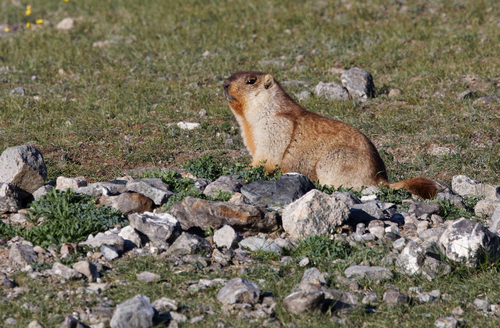
This species, commonly called the tarbagan marmot, is a medium-sized marmot relative to other species in its genus. It has a 0.25 head-to-body length ratio.
Fur Length
Its summer fur measures 11–20 mm in length, and grows to 30 mm long during winter.
Fur and Cheek Coloration
The fur features two distinct slate-colored bands, followed by a white band, and the marmot’s cheeks are yellow.
Zygomatic Arch Structure
Compared to other marmot species, its zygomatic arches are slightly expanded.
Skull Variation
Tarbagan marmot populations in western Mongolia typically have wider skulls than other populations of the species.
Sexual Dimorphism and Weight
Males are larger and heavier than females; the average weight for both sexes combined is 6–8 kg.
Habitat Type
The tarbagan marmot is one of only two marmot species that inhabit lowland areas; the other is the groundhog.
Diet
Like all marmots, the tarbagan marmot is herbivorous, and feeds primarily on steppe grasses.
Native Range
Its native range is centered mainly across Mongolia, extending west to the Altai Mountains, east to Inner Mongolia, north to Transbaikal, and south to the Dzungarian Basin in the Gobi Desert.
Ecosystem Engineering Role
The tarbagan marmot acts as an ecosystem engineer, providing a range of important resources for other organisms.
Burrow Ecosystem Benefits
Its burrow networks create basking sites for thermoregulation, feeding areas, and refuges for other species, which can produce more suitable habitats and increase the survivability of these other species.
Prey Role
Additionally, tarbagan marmots are a major food source for raptors and carnivorous species including gray wolves and golden eagles.