About Cynomys parvidens J.A.Allen, 1905
Species Classification and Endemic Status
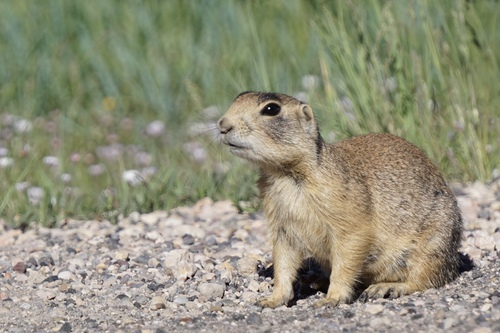
The Utah prairie dog (Cynomys parvidens) is the smallest prairie dog species, and it is endemic to the south-central steppes of Utah, United States.
Conservation Status
It is classified as Endangered on the IUCN Red List of Threatened Species, and is protected as a result.
Primary Threats
The species faces multiple threats, with habitat loss and disease being the most dangerous.
Geographic Range Overview
Utah prairie dogs are found only in southern Utah, and have the smallest restricted range of the five United States prairie dog species.
Related Species Distribution
The other four species (Gunnison's prairie dog, Mexican prairie dog, white-tailed prairie dog, and black-tailed prairie dog) have no overlapping geographic territories with this species.
Current County Distribution
Currently, Utah prairie dogs only occur in central and southwestern Utah, in Beaver, Garfield, Iron, Kane, Piute, Sevier, and Wayne Counties.
1920 Historical Range
In 1920, populations were recorded ranging as far north as Nephi, as far south as the pine-fir forests of Bryce Canyon National Park, and east to the Aquarius Plateau.
20th Century Population Decline
Between the 1920s and 1970s, the Utah prairie dog population declined by 87%. This decline is thought to have been caused by human settlers leading to overgrazing, which allowed shrubs to invade the species' grassland habitat.
Preferred Habitat Vegetation
Utah prairie dogs prefer swale areas with abundant herbaceous plants.
Burrow Construction Requirements
They build burrows in soil that has adequate drainage, enough depth (a minimum of 3.3 feet/1.0 m) to protect them from predators, and appropriate coloration for camouflage. Environmental factors such as temperature also impact burrow construction, through insulation needs.
Agricultural Habitat Risks
Agricultural lands often provide suitable habitat for Utah prairie dogs, but when populations become too dense, plague outbreaks (which are typically vectored by fleas) become common and can wipe out entire colonies.
Reproductive Behavior Basics
Utah prairie dogs exhibit polyandrous behavior, and produce only one litter per year.
Litter Size Characteristics
Litters generally contain one to eight pups, with an average of 3.88 pups. Litter size correlates directly with maternal body mass.
Juvenile Mortality Cause
Approximately twenty percent of juvenile Utah prairie dogs are killed by cannibalism from adult males.
Breeding and Gestation Timeline
The gestation period for females is approximately 28 days, and breeding typically takes place from mid-March to early April.
Female Estrus Cycle
Female estrus occurs only once per breeding season, lasting just a few hours on a single day.
Reproductive Viability
This unusual reproductive cycle remains viable because an average of 97% of adult females are in condition to breed and successfully produce litters.
Life Expectancy
The life expectancy of Utah prairie dogs is around five years.