About Marmota himalayana (Hodgson, 1841)
Fur and Coloration
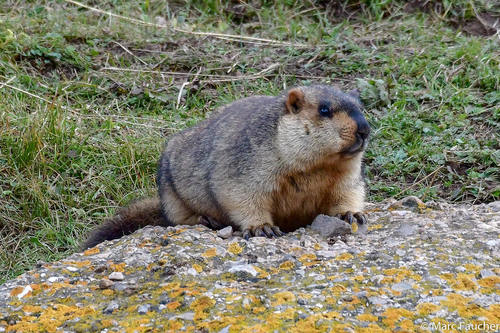
The Himalayan marmot (Marmota himalayana) has dense, woolly fur: it is rufous grey on the back, and rufous yellowish on the ears, belly, and limbs. The bridge of the nose and the end of the tail are dark brown.
Size
It is one of the largest marmot species in the world, around the size of a large housecat. Its average body weight ranges from 4 to 9.2 kg (8.8 to 20.3 lb); weights are lowest after hibernation in spring, and highest before hibernation in autumn. In autumn, the average weight of both sexes is reported to be over 7 kg (15 lb).
Body Measurements
Total body length ranges from about 45 to 67 cm (18 to 26 in), and tail length ranges from 12 to 15 cm (4.7 to 5.9 in).
Altitudinal Range
This species lives in the Himalayas and Tibetan Plateau, at altitudes between 3,000 and 5,500 m (9,800 and 18,000 ft). Its range covers northeastern Pakistan, northern India, Nepal, Bhutan, and China.
Country-Specific Distribution
In India, it occurs in high-altitude regions of Ladakh. In China, it has been recorded in Xinjiang, Qinghai, Gansu, Tibet, western Sichuan, and Yunnan. To the west, its distribution meets the range of the long-tailed marmot (M. caudata), but the two species are not known to hybridize.
Habitat Preferences
Himalayan marmots inhabit short grass steppes or alpine habitats, typically found above the tree line and below the permanent snow line.
Colony and Hibernation Burrows
Himalayan marmots live in colonies and dig deep burrows that all colony members share during hibernation. They hibernate from late autumn to early spring, for an average of 7 and a half months each year.
Burrow Specifications
Their burrows are between 2 and 10 m (6 ft 7 in to 32 ft 10 in) deep, and are built in areas where the upper soil layer is sufficiently light and deep, such as fluvioglacial, deluvial, and alluvial deposits. In ideal soil conditions on alluvial terraces, marmot colonies can include up to 30 families, with up to 10 families living in one 1 km2 (0.39 sq mi) area.
Diet
The species feeds on pasture plants, especially the soft, juicy parts of grassy species including Carex, Agrostis, Deschampsia, and Koeleria, and flowering species including Euphrasia, Gentiana, Halenia, Polygonum, Primula, Ranunculus, Saussurea, Taraxacum, and Iris potaninii.
Human Interaction Risks
In Ladakh, Himalayan marmots interact with humans that feed them. This has caused the marmots to develop reduced survival instinct behavior, leaving them easy prey for stray dogs and other natural predators.
Reproduction
For reproduction, female Himalayan marmots reach sexual maturity at two years old. After a one-month gestation period, they give birth to litters of 2 to 11 young.