About Macrotus californicus Baird, 1858
Scientific Name
Macrotus californicus Baird, 1858
Physical description
Size and Color
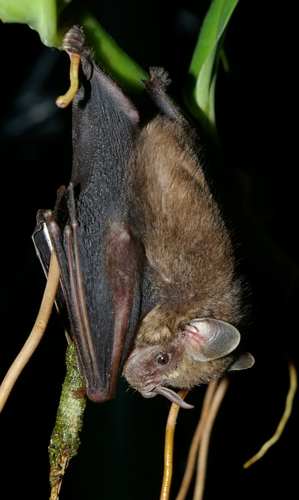
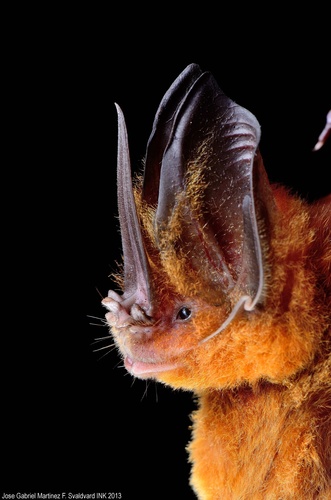
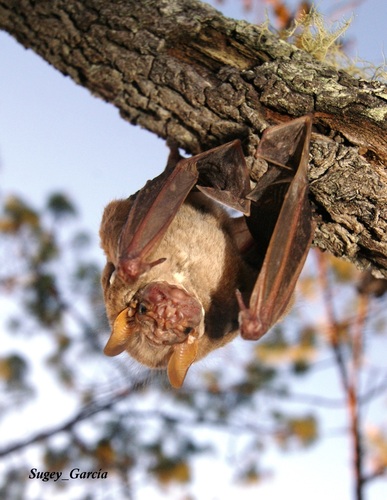
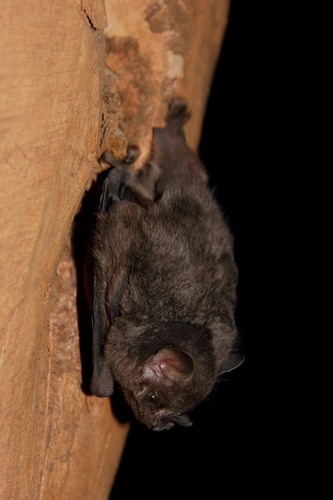
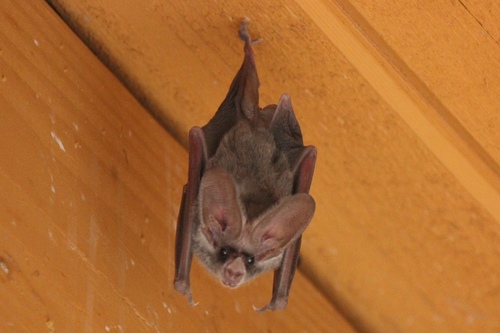
The California leaf-nosed bat weighs between 12 and 20 grams, has a wingspan of over 30 centimeters, a body length of over 6 centimeters, and is brown in color. As its name implies, it has a triangular fleshy skin growth called a noseleaf protruding above the nose. Among bats of the family Phyllostomidae in the United States, this is the only species with large ears that usually measure over 2.5 centimeters.
Flight and Maneuverability
It is also one of the most maneuverable bats in flight. M. californicus only spreads its uropatagium widely when hovering or performing other maneuvers that require a departure from straight level flight. The extreme maneuverability observed in M. californicus is probably due to specializations of its sensory equipment. It has short, broad wings that allow it to fly at low speeds using minimal energy. Because of this adaptation, it is not suited for long-distance travel, and it is non-migratory.
Reproduction
This bat has an unusual reproductive pattern. After breeding occurs in the fall, the embryos develop very slowly until March, when growth continues at a more normal rate before birth in May or June. Twins are common.
Anatomy
In Macrotus, the position of the hind limbs during level flight differs even more from that in most other mammals. The hind limbs are held behind the bat in a spider-leg-like posture: the femur extends dorsad and caudad, while the shank is partially flexed and extends caudad and more or less downward. Like all other species in the genus Macrotus, it has twelve thoracic, six lumbar, five sacral, and seven caudal vertebrae.
Habitat
California leaf-nosed bats can be found in Sonoran and Mojave Desert scrub habitats in the Colorado River valley in southern California, Nevada and Arizona, and throughout western Mexico. It is non-migratory and does not hibernate.