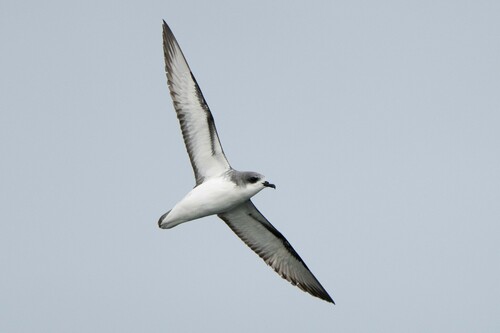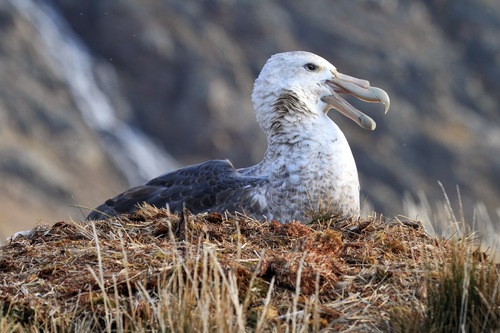
About Macronectes giganteus (Gmelin, 1789)
Body Length and Wingspan
The southern giant petrel (Macronectes giganteus) measures 86 to 99 cm (34–39 in) in length, with a wingspan of 185 to 205 cm (6 ft 1 in – 6 ft 9 in).
Interspecies and Colony Size Variability
Both this species and the northern giant petrel show considerable size variability, with southern colonies of the southern giant petrel averaging larger than northern colonies, which aligns with Bergmann's rule. Due to this wide size variation, it is difficult to confirm whether the southern giant petrel is larger overall than the northern giant petrel, but the largest-bodied southern giant petrel colonies are slightly larger on average in both body mass and linear body dimensions than the largest northern giant petrel colonies.
Sexual Size Dimorphism and Mass Range
Males tend to be larger than females, and body mass varies widely across the species, ranging from 2.3 to 5.6 kg (5.1–12.3 lb).
Average Mass at Macquarie Island
The highest average weights recorded for the species come from Macquarie Island, where 20 sampled males averaged 5.14 kg (11.3 lb) and 21 sampled females averaged 4.2 kg (9.3 lb).
Average Mass at South Orkney Islands
On the South Orkney Islands, 37 sampled males averaged 4.94 kg (10.9 lb) and 37 sampled females averaged 3.85 kg (8.5 lb).
Average Mass at Patagonian Study Sites
In contrast, one study in Patagonia found 15 sampled males averaged 3.5 kg (7.7 lb) and 21 sampled females averaged 2.5 kg (5.5 lb), while a separate Patagonian study found 26 sampled males averaged 4.2 kg (9.3 lb) and 27 sampled females averaged 3.7 kg (8.2 lb).
Bill and Leg Morphology
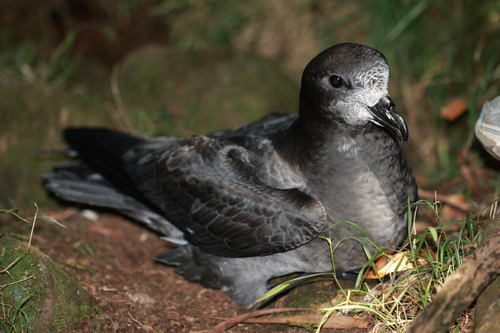
Southern giant petrels have a very large yellow bill with a green tip, and greyish-brown legs.
Plumage Morphs
There are two distinct plumage morphs: a dark morph that resembles the northern giant petrel, and a more distinct, rarer light morph.
Dark Morph Plumage Details
For the dark morph, the upper breast, head and neck are light, while the rest of the plumage is mottled brown. The leading edge of the wing, and the base of the inner primaries on the underside of the wing, are also lighter in color.
Light Morph Plumage Details
The light morph is very distinct, with an almost entirely white plumage that only has slight black speckles.
Juvenile Dark Morph Plumage
Juvenile dark morph southern giant petrels are a darker sooty brown when young, and pale as they age.
Terrestrial Locomotion Ability
Like all giant petrels, this species has strong legs and can move effectively on land.
Flight Appearance
In flight, this species has a somewhat hunchbacked appearance.
Shared Procellariiformes Traits
Like all members of the order Procellariiformes, this species has specific traits that distinguish it from other bird groups. First, it has nasal passages called naricorns that attach to the upper bill, with the nostrils located on the top of the bill.
Procellariiformes Bill Structure
The bills of all Procellariiformes are also unique in that they are split into between seven and nine separate horny plates.
Stomach Oil Production
Southern giant petrels produce a stomach oil made of wax esters and triglycerides that is stored in the proventriculus.
Stomach Oil Functions
This oil can be sprayed from the mouth as a defense against predators, and also serves as an energy-rich food source for chicks, and for adult birds during their long flights.
Salt Gland Adaptation
Above the nasal passage, the species has a salt gland that helps remove excess salt from the blood. This adaptation is needed because salt (primarily sodium chloride) is present both in their marine invertebrate food and in the large amount of ocean water they drink; the gland excretes a concentrated salt solution out through the nostrils.
Overall Species Range
The southern giant petrel has an extensive range, stretching from Antarctica to the subtropics of Chile, Africa, and Australia.
Breeding Site Distribution
It breeds on numerous islands throughout the southern oceans.
Large Population Breeding Islands
Islands with larger southern giant petrel populations include the Foveaux Strait, Falkland Islands, South Georgia, South Orkney Islands, Staten Island, South Shetland, Heard Island, Macquarie Island, the Prince Edward Islands, and the Crozet Islands.
Small Population Breeding Sites
Smaller populations occur on the Kerguelen Islands, Gough Island, Tristan da Cunha, Diego Ramirez, Isla Noir, four locations on the Antarctic continent including Terre Adélie, and small islands off the coast of Argentina near Chubut Province.
Colony Visitation Pattern
Colonies of this species are visited year round.