About Macaca nigra (Desmarest, 1822)
Local Common Names
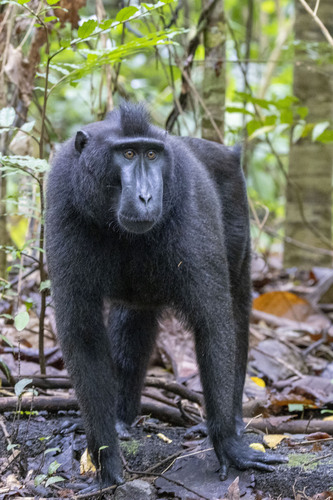
Locally known as yaki, wolai, or bolai, this species has entirely jet black skin and hairless face, except for a patch of white hair on the shoulders.
Facial and Head Features
It features a long muzzle with high cheeks, a long hair tuft or crest at the top of its head, and unusual striking reddish-brown eyes for a primate.
Rump Pad Trait
Uniquely among macaques, males and young females have a heart-shaped skin pad on the rump.
Tail Structure
Although it has a distinctly ape-like appearance, it only has an almost non-existent, non-visible vestigial tail stub that measures approximately 2 cm (0.8 in) long.
Size and Weight
Females reach a length of 44 to 55 cm (17 to 22 in) and a weight of up to 2.5 kg (5.5 lb), while males grow to 52 to 57 cm (20 to 22 in) in length and 9.5 to 12.7 kg (21 to 28 lb) in weight, making this one of the smaller macaque species.
Lifespan
Its life expectancy is estimated at 18 years in the wild, with a maximum recorded lifespan of 34 years in captivity.
Subpopulations
This species has around eight subpopulations, with an introduced population located on the island of Bacan.
Habitat Preference
It prefers closed canopy forests, and has higher occupancy within protected areas.
Activity Pattern
The Celebes crested macaque is a diurnal dweller of rain forests.
Terrestrial and Arboreal Behavior
It is primarily terrestrial, spending more than 60% of its daytime on the ground foraging and socializing, while it sleeps and searches for additional food in trees.
Diet Composition
It is frugivorous, with 70% of its diet made up of fruits.
Additional Food Items
It also eats leaves, buds, seeds, mushrooms, small birds, bird eggs, insects including beetles and caterpillars, worms, snails, spiders, and occasionally small lizards or frogs.