About Lynx rufus (Schreber, 1777)
Scientific name: Lynx rufus (Schreber, 1777)
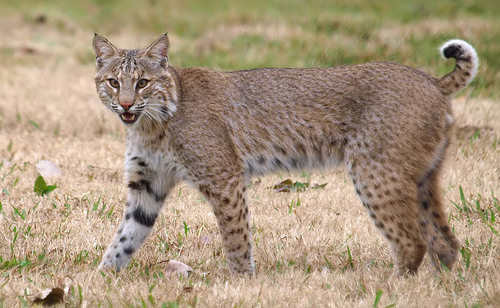
Description: The bobcat resembles other midsize species in the genus Lynx, and is on average the smallest of the four species in this genus. Its coat color varies, though it is generally tan to grayish-brown, marked with black streaks across the body and dark bars on the forelegs and tail. Its spotted patterning works as camouflage. The ears are pointed with black tips and short black tufts. The lips, chin, and underparts are generally off-white. Bobcats from the desert regions of the American southwest have the lightest coats, while those from northern forested regions have the darkest. Kittens are born with a full fur coat and already have their spots. A small number of melanistic bobcats have been sighted and captured in Florida, USA, and New Brunswick, Canada. These individuals appear black, but may still show a visible spot pattern. The bobcat’s face looks wide because of ruffs of extended hair that grow beneath the ears. Its eyes are yellow with black slit pupils. The bobcat’s nose is pinkish-red, and the base fur color of its face, sides, and back is gray, yellowish-red, or brownish-red. The pupils widen during nocturnal activity to maximize the amount of light the eyes can capture. The bobcat has sharp hearing and vision, plus a good sense of smell. It is an excellent climber, and will swim when it needs to, though it normally avoids water. Adult bobcats measure 47.5–125 cm (18.7–49.2 in) from the head to the base of their distinctive stubby tail, with an average length of 82.7 cm (32.6 in); the tail itself is 9 to 20 cm (3.5 to 7.9 in) long. The species gets its common name from the tail’s characteristic "bobbed" appearance. Adults stand about 30 to 60 cm (12 to 24 in) tall at the shoulders. Adult male bobcats weigh between 6.4–18.3 kg (14–40 lb), with an average weight of 9.6 kg (21 lb); females weigh between 4–15.3 kg (8.8–33.7 lb), with an average weight of 6.8 kg (15 lb). The largest accurately measured bobcat on record weighed 22.2 kg (49 lb), though unverified reports note individuals reaching 27 kg (60 lb). Additionally, a June 20, 2012 report of a roadkill specimen from New Hampshire listed its weight as 27 kg (60 lb). The largest-bodied bobcats have been recorded in eastern Canada and northern New England, while the smallest are found in the southern Appalachian Mountains. In keeping with Bergmann's rule, bobcats are larger in their northern range and in open habitats. A morphological size comparison study in the eastern United States found a divergence in the location of the largest male and female specimens, which suggests the two sexes face differing selection constraints. Skeletal muscles make up 58.5% of a bobcat's total body weight. At birth, a bobcat weighs 270–340 g (9 1⁄2–12 oz) and measures about 25 cm (10 in) in length. By one year of age, it weighs roughly 4.5 kg (10 lb).
Distribution and habitat: The bobcat is an adaptable species. It prefers woodlands—whether deciduous, coniferous, or mixed—but it does not rely exclusively on deep forest. Its range extends from the humid swamps of Florida to the desert lands of Texas and rugged mountain areas. It will establish its home near agricultural areas, as long as rocky ledges, swamps, or forested tracts are present; its spotted coat provides camouflage in these settings. A bobcat population size depends primarily on the population size of its prey; other main factors that influence habitat selection include protection from severe weather, availability of resting and den sites, dense cover for hunting and escape, and freedom from human or other disturbance. The bobcat's range does not appear to be limited by human populations, only by the availability of suitable habitat; only large, intensively cultivated tracts of land are unsuitable for the species. Bobcats may even appear in backyards in "urban edge" environments, where human development borders natural habitats. If chased by a dog, a bobcat will usually climb a tree. The historical range of the bobcat extended from southern Canada, across the entire United States, and as far south as the Mexican state of Oaxaca, and the species still persists across most of this original range. During the 20th century, it was thought to have lost territory in the US Midwest and parts of the Northeast, including southern Minnesota, eastern South Dakota, and most of Missouri, mostly because of habitat changes brought by modern agricultural practices. While bobcats were once thought to no longer exist in western New York and Pennsylvania, multiple confirmed sightings (including dead specimens) have been reported recently in New York's Southern Tier and central New York, and a bobcat was captured in 2018 on a tourist boat in Downtown Pittsburgh, Pennsylvania. In addition, confirmed bobcat sightings have been recorded in northern Indiana, and one was killed near Albion, Michigan in 2008. In early March 2010, a bobcat was sighted (and later captured by animal control authorities) in a parking garage in downtown Houston. By 2010, bobcats appeared to have recolonized many US states, and are present in every state of the contiguous 48 except Delaware. In Canada, the bobcat population is limited by both snow depth and the presence of the Canada lynx. The bobcat cannot tolerate deep snow, and waits out heavy storms in sheltered areas; it lacks the large padded feet of the Canada lynx, and cannot support its weight on snow as efficiently. The bobcat is not entirely at a disadvantage where its range overlaps with the larger Canada lynx: aggressive bobcats have been observed displacing Canada lynx when they interact in Nova Scotia, while the clearing of coniferous forests for agriculture has led to a northward retreat of the Canada lynx's range, which benefits the bobcat. In northern and central Mexico, the bobcat is found in dry scrubland and pine and oak forests; its range ends at the tropical southern portion of the country.
Social structure and home range: Bobcat activities are confined to well-defined territories, whose size varies based on the individual's sex and the distribution of prey. Bobcats mark their home ranges with feces, urine scent, and by clawing prominent trees in the area. Within its territory, a bobcat has multiple shelter sites, usually one main den and several auxiliary shelters along the outer edges of its range, such as hollow logs, brush piles, thickets, or spaces under rock ledges. The main den smells strongly of the bobcat. Home range sizes of bobcats vary significantly, ranging from 0.596–326 km² (0.23–126 sq mi). One study in Kansas found that resident males had home ranges of roughly 21 km² (8 sq mi), while females had ranges less than half that size. Transient bobcats had home ranges of 57 km² (22 sq mi) with less clear boundaries. Kittens had the smallest ranges, at about 8 km² (3 sq mi). Dispersal away from the natal range is most pronounced for males. Reports on seasonal variation in range size have been conflicting. One study found a large variation in male range sizes, from 41 km² (16 sq mi) in summer up to 104 km² (40 sq mi) in winter. Another study found that female bobcats, especially reproductively active ones, expanded their home range in winter, but males only shifted their range without expanding it, a finding consistent with numerous earlier studies. Other research conducted in various American states has found little or no seasonal variation in range size. Like most felines, the bobcat is largely solitary, but individual home ranges often overlap. Unusually for cats, males are more tolerant of range overlap, while females rarely wander into other females' ranges. Because of their smaller range sizes, two or more females may live within a single male's home range. When multiple territories overlap, a dominance hierarchy is often established, which results in some transients being excluded from favored areas. In line with the wide variation in reported home range sizes, population density estimates vary from one to 38 bobcats per 26 km² (10 sq mi) in one survey. The overall average is estimated at one bobcat per 13 km² (5 sq mi). A link has been observed between population density and sex ratio. An unhunted population in California had a sex ratio of 2.1 males per female. When population density decreased, the sex ratio skewed to 0.86 males per female. Another study observed a similar ratio, and suggested that males may be better able to cope with increased competition, and this helps limit reproduction until various factors lower the population density.
Behavior and ecology: The bobcat is crepuscular, and is active mostly during twilight. It remains active from three hours before sunset until around midnight, then becomes active again from before dawn until three hours after sunrise. Each night, it travels 3 to 11 km (2 to 7 mi) along its habitual route. This activity pattern may vary seasonally: bobcats become more diurnal during fall and winter, in response to the activity of their prey, which are more active during the day in colder weather.
Reproduction and life cycle: The average lifespan of a wild bobcat is seven years, and individuals rarely exceed 10 years. The oldest wild bobcat on record lived to 16 years old, and the oldest captive bobcat lived to 32. Bobcats generally begin breeding by their second summer, though females may start breeding as early as their first year. Sperm production begins each year by September or October, and males remain fertile into the summer. A dominant male travels with a female and mates with her several times, generally from winter until early spring; the timing of mating varies by location, but most mating takes place during February and March. The pair may engage in a number of behaviors during mating, including bumping, chasing, and ambushing. Other males may be nearby, but do not participate. Once the male recognizes the female is receptive, he grasps her with the typical felid neck grip and mates. The female may later mate with other males, and males generally mate with multiple females. During courtship, bobcats produce vocalizations including screaming and hissing. Research in Texas found that establishing a home range is necessary for breeding; no offspring were identified for studied animals that lacked a home range. The female has an estrous cycle of 44 days, with estrus itself lasting five to ten days. Bobcats remain reproductively active throughout their entire lives. The female raises her young alone. Between one and six kittens, usually two to four, are born in April or May, after roughly 60 to 70 days of gestation. Occasionally, a second litter is born as late as September. The female generally gives birth in an enclosed space, usually a small cave or hollow log. The young open their eyes by the ninth or tenth day after birth. They begin exploring their surroundings at four weeks old, and are weaned at around two months old. Within three to five months, they start traveling with their mother. They hunt on their own by the fall of their first year, and usually disperse shortly after that. In Michigan, however, bobcat kittens have been observed staying with their mother as late as the following spring.