About Lynx canadensis Kerr, 1792
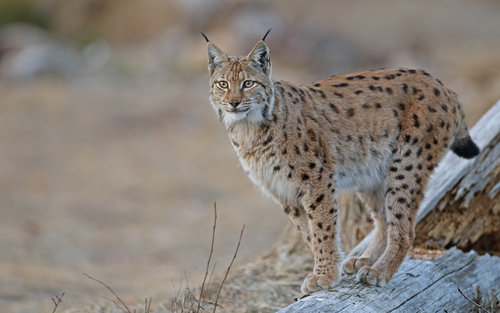
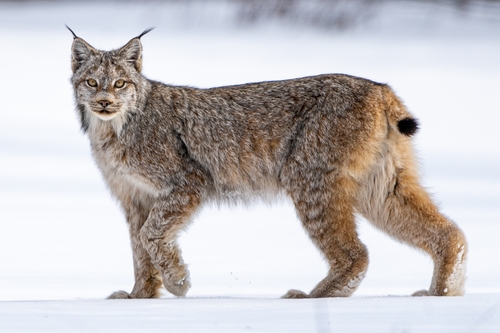
The Canada lynx (Lynx canadensis Kerr, 1792) is a lean, medium-sized wild cat. It is identified by long, dense fur, triangular ears with black tufts at the tips, and broad, snowshoe-like paws. Like the bobcat, its hindlimbs are longer than its forelimbs, which makes its back slope downward toward the front. This species shows sexual dimorphism: males are larger and heavier than females. Total body length ranges from 73 to 107 cm (29 to 42 in), and shoulder height is 48–56 cm (19–22 in). Females weigh 5–12 kg (11–26 lb), while males weigh 6–17 kg (13–37 lb); one exceptional male from Pennsylvania weighed 20 kg (44 lb). Physical body proportions do not change significantly across the species' range, and are likely naturally selected to support survival on smaller prey. Its stubby tail is 5–13 cm (2.0–5.1 in) long and has a completely black tip. Skeletal muscle makes up 56.5% of the Canada lynx's body weight. Its long, thick fur is mostly uniformly colored with little to no markings except on the underside, and insulates the lynx in cold habitats. Fur is typically yellowish brown; in Newfoundland, fur changes with the season, shifting from brown or buff-grey in spring and summer to a grizzled greyish shade in winter. The underparts are white and may have a small number of dark spots. One individual from Alaska was recorded to have bluish-grey fur. Fur is generally shorter in summer than in winter. The backs of the ears are brown, with a silvery-grey spot at the center. The black ear tufts are around 4 cm (1.6 in) long, and the inner ear is lined with black fur. In winter, fur on the lower cheek grows longer, forming a ruffle-like appearance that covers the throat. Canada lynxes have four nipples, sharp, fully retractile claws. Their large, broad paws are covered in long, thick fur and can spread as wide as 10 cm (3.9 in), which lets them move quickly and easily across soft snow. Their paws can support almost twice as much weight as a bobcat's paws before sinking into snow. Both Canada lynxes and bobcats typically step with their back foot in the track of their front foot, and often do not follow a straight path. The Canada lynx's stride measures 300–460 mm (12–18 in), while the bobcat's stride ranges from 130 to 410 mm (5 and 16 in). Canada lynx tracks are generally larger than bobcat tracks; thick fur on the paws can make the toe pads less visible in snow. In dirt, lynx tracks measure 76–95 mm (3–3.75 in) long and 89–114 mm (3.5–4.5 in) wide, while tracks in snow are larger, at 110 mm (4.5 in) long and 130 mm (5 in) wide. The lynx's warm coat, wide paws and long legs are adaptations that let it navigate and hunt efficiently in snowy environments. The Canada lynx has 28 teeth, with a dental formula of 3.1.2.1 / 3.1.2.1. Young lynxes have deciduous dentition with a formula of 3.1.2 / 3.1.2, as they do not develop molars as juveniles. The four long canines are used for puncturing and gripping prey; these canines have a high density of nerves, so the lynx can feel where it is biting prey. It also has four carnassial teeth that cut meat into small pieces; to use these carnassials, the lynx must chew with its head turned to the side. There are large gaps between the four canines and the rest of the teeth, and the second upper premolars are missing. This adaptation allows the lynx to bite as deeply as possible into prey. Canada lynxes can be distinguished from bobcats by their longer ear tufts, broader paws, shorter tail with a fully black tip, longer legs, fewer body markings, and generally greyer coat. Bobcats are typically smaller than Canada lynxes, but in areas where the two species share range, bobcats tend to grow larger and may still be confused with Canada lynxes. The Canada lynx lives primarily in the dense boreal forest of Canada, and its range closely matches the range of the snowshoe hare, its primary prey. Historically, the lynx lived across 24 northern U.S. states, ranging as far south as the Rocky Mountains in New Mexico, and as far north as the Arctic tree line through coniferous forests in Alaska and Canada. The lynx still occupies most of its historical range across Alaska and Canada. In the United States, the Canada lynx is found in the Blue Mountains and Cascade Range in the Pacific Northwest, the Rocky Mountains, the northern Great Lakes region (Minnesota and Michigan's Upper Peninsula), and northern New England (New Hampshire, Maine and Vermont). After being extirpated from Colorado in the 1970s, the lynx was successfully reintroduced to the state starting in 1999. Canada lynxes generally avoid open areas even when prey is abundant, and struggle to survive in heavily logged areas and agricultural land. However, they can thrive in deforested areas that have been left to regenerate for at least fifteen years. They have been recorded at elevations up to 4,310 m (14,140 ft). The species is considered extirpated in New York, Pennsylvania, Massachusetts, Nevada, Indiana, and Ohio. In February 2022, a hunter photographed a large male Canada lynx in the southern Gros Ventre Range of Wyoming after his hounds treed the animal; this is the first confirmed sighting of the species in the state since 2012. Canada lynxes are generally nocturnal, matching the activity pattern of their primary prey, the snowshoe hare, though they may also be active during the day. To find prey, lynxes can travel 8–9 km (5.0–5.6 mi) per day, moving at a speed of 0.75–1.46 km/h (0.47–0.91 mph). Canada lynxes are good swimmers; one record documents a Canada lynx swimming 3.2 km (2 mi) across the Yukon River. They are also efficient climbers, and will climb high into trees to escape predators, but only hunt on the ground. Canada lynxes are primarily solitary, with very little social interaction outside of the bond between mothers and their female offspring, and temporary pairing of opposite-sex individuals during the mating season. Same-sex individuals typically avoid one another, maintaining intrasexual territories; this social structure is similar to that of bears, bobcats, cougars and mustelids. Intraspecific aggression and resulting cannibalism are rare, but may become more common when food is scarce. The Canada lynx mating season lasts about one month, from March to early April. Males and females increase their interactions through behaviors including urine marking and mating calls. Females can be induced ovulators when few mates are available, or spontaneous ovulators when multiple mates are available. Females only have one estrus cycle per mating season, with estrus lasting three to five days when observed in captivity. Lynxes have been recorded making long wailing vocalizations, likely used as mating calls. Before giving birth, the female builds a maternal den, usually located in very thick brush, most often inside thickets of shrubs or trees, or among woody debris. After a gestation period of two to three months, a litter of one to eight kittens is born. The lynx's reproductive cycle and litter size change based on prey availability: litter sizes typically shrink during years when snowshoe hare populations decline (along with higher infant mortality rates), and grow when hares are abundant. Kittens weigh 175 to 235 g (6.2 to 8.3 oz) at birth, and are born with greyish buff fur marked with black spots. They are blind for the first 14 days after birth and are weaned at 12 weeks. Most births happen between May and July. Kittens leave the den after about five weeks, and start hunting between seven and nine months of age. They leave their mother at around ten months old, when the next breeding season begins, but do not reach full adult size until roughly two years of age. Female offspring usually establish home ranges near their mothers and remain in contact with them for life, while male offspring move far from their mother's home range. Females reach sexual maturity at ten months old, but often delay breeding for an additional year. Males reach sexual maturity at two or three years old. Canada lynxes have been recorded living up to 16 years in the wild, though most do not survive longer than 10 years; in captivity, they can live up to 27 years.