About Lycalopex gymnocercus (G.Fischer, 1814)
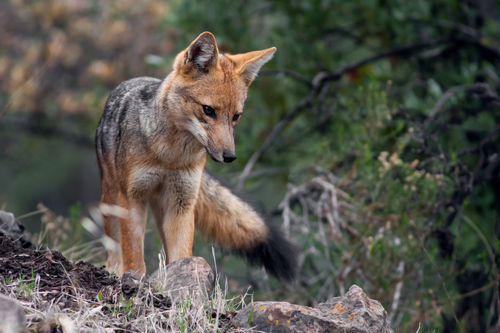
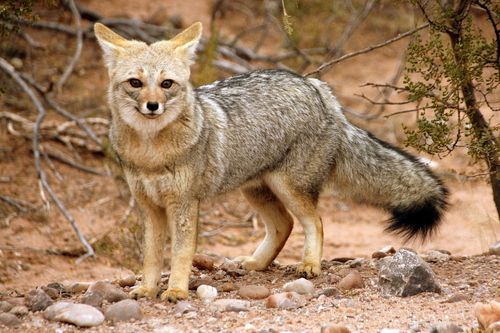
Lycalopex gymnocercus, commonly known as the Pampas fox, resembles the culpeo or Andean fox in size and general appearance. It can be distinguished by a proportionately wider snout, reddish fur on the head and neck, and a black marking on the muzzle. Most of its body is covered in short, dense grey fur, with a black stripe running down its back and onto the tail, while its underparts are pale, nearly white. Its ears are triangular, broad, and relatively large; the outer ear surface is reddish, and the inner surface is white. The inner surfaces of the Pampas fox's legs match the pale color of its underparts. The outer surface of the fore limbs is reddish, and the outer surface of the hind limbs is grey, with a distinctive black spot on the lower hind limb. Adult Pampas foxes have a body length between 51 and 80 cm (20 to 31 in), and weigh between 2.4 and 8.0 kg (5.3 to 17.6 lb); males are typically around 10% heavier than females. Individuals living in the northern part of the species' range have richer coloration than those in the southern part. The Pampas fox is found primarily in northern and central Argentina, Uruguay, eastern Bolivia, Paraguay, and southern Brazil. It prefers open pampas habitats, often located close to agricultural land, but can also occur in montane or chaco forest, dry scrubland, and wetland habitats. It is most common at elevations below 1,000 m (3,300 ft), but can live in puna grasslands up to 3,500 m (11,500 ft). As of 2005, five subspecies of L. gymnocercus are generally recognized. L. g. antiquus is found in the Pampas grasslands, Monte shrublands and Espinal open woodlands of central Argentina, ranging from Córdoba and San Luis Provinces to the Río Negro and the Atlantic coast. L. g. domeykoanus is found in Copiapó Province, Chile. L. g. gracilis is found in the Pampas surrounding Mendoza, Argentina. L. g. gymnocercus is found in the subtropical grasslands of northeastern Argentina, Uruguay, Paraguay, Bolivia and eastern Brazil. L. g. maullinicus is found in Llanquihue Province, Chile, east of Llanquihue Lake. An earlier 1982 taxonomical revision only recognized L. g. antiquus and L. g. gymnocercus, and also included the otherwise unaccepted subspecies L. g. lordi, which is restricted to the Chaco-Yungas Mountain Tropical Forest in Salta and Jujuy Provinces. That revision classified L. g. domeykoanus, L. g. gracilis, and L. g. maullinicus as subspecies of L. griseus, in part because they fall outside the currently accepted range of L. gymnocercus. Fossils of this species dating to the late Pliocene to early Pleistocene have been found in Argentina. Pampas foxes breed in early spring, and females enter estrus just once per year. After a 55 to 60 day gestation period, a female gives birth to a litter of up to eight kits. Young are born between September and December, and are weaned at around two months of age. Females reach sexual maturity in their first year, and captive Pampas foxes have been recorded living up to 14 years. Pups stay in dens until at least 3 months old, when they begin hunting with their parents. Males bring food to females, who remain at the den with the kits.