About Chalcostigma herrani (Delattre & Bourcier, 1846)
Taxonomy and Common Name
The rainbow-bearded thornbill (scientific name Chalcostigma herrani (Delattre & Bourcier, 1846)) measures 10 to 12 cm (3.9 to 4.7 in) in total length.
Size and Weight
Males weigh approximately 6.2 g (0.22 oz), while females weigh approximately 5.6 g (0.20 oz). Individuals of both sexes have a short, needle-shaped bill.
Nominate Male Plumage
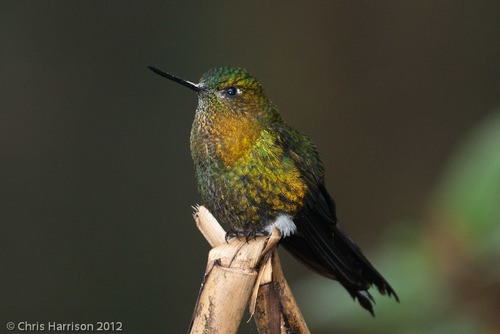
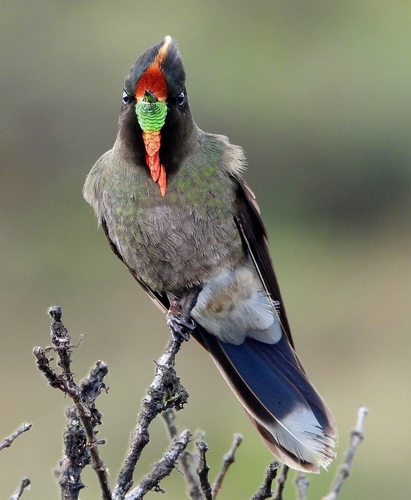
Adult males of the nominate subspecies are mostly bottle green, with a white spot behind the eye, and rufous coloring on the forecrown and crown. They have black primary flight feathers, a coppery rump, and white undertail coverts.
Nominate Male Tail Structure
Their forked tail is blue-black, with prominent white tips at the corners that are most visible when viewed from below.
Nominate Male Gorget
The gorget, or "beard", has a rainbow gradient of colors: starting at celadon-green near the top, moving through turquoise, and ending with yellow and red at the lower end. Their feet are black.
Adult Female Plumage
Adult females are generally similar in appearance to males, but have pale yellowish-ochre coloring from the lower belly to the undertail coverts, and a much smaller gorget.
Juvenile Plumage
Juvenile birds are similar in appearance to adult females, but juvenile males have an entirely dark throat.
Subspecies C. h. tolimae Plumage
The subspecies C. h. tolimae is very similar to the nominate subspecies, but is darker overall and has a longer gorget.
Nominate Subspecies Distribution
The nominate subspecies of rainbow-bearded thornbill occurs from the Western Andes of Colombia in Cauca Department, through Ecuador along both slopes of the Andes, into the northern Peruvian departments of Piura and Cajamarca.
C. h. tolimae Distribution
C. h. tolimae is found only at Nevado del Tolima in Colombia's Central Andes.
Elevation Range
This is a high-elevation species, most commonly found between 2,700 and 4,100 m (8,900 and 13,500 ft) in Colombia, and between 2,800 and 3,700 m (9,200 and 12,100 ft) in Ecuador.
Habitat
Its primary habitat includes paramo, open landscapes with bushy patches and small woodlands, and gullies with thickets of ferns and bromeliads.