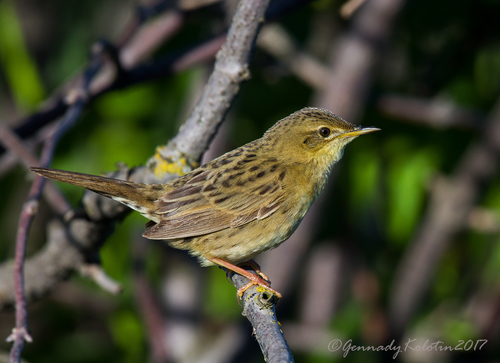
About Locustella naevia (Boddaert, 1783)
Scientific Nomenclature
Common grasshopper warbler has the scientific name Locustella naevia (Boddaert, 1783).
Adult Size and Weight
Adult common grasshopper warblers measure about 12.5 cm (5 in) in length and weigh 11.5–16 grams (0.41–0.56 oz).
Detectability Note
This is a secretive bird that can be hard to see, but its presence is easily detected by its characteristic song.
Upperpart Plumage
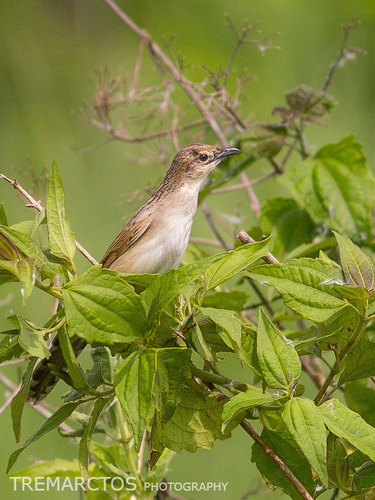
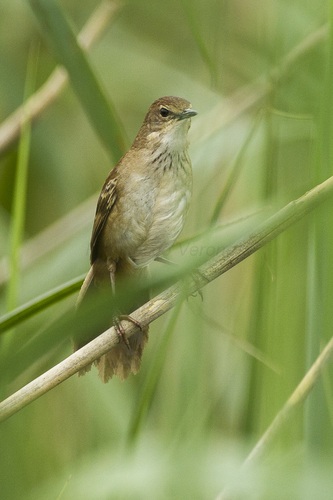
Its upperparts are pale olive-brown, with each feather bearing a central darker brown streak.
Head and Facial Features
Cheeks are greyish, irises are brown, and there is a faint eye streak behind the eye.
Beak Structure
The upper mandible of the beak is dark brown, while the lower mandible is yellowish-brown.
Underpart Plumage
Underparts are cream-coloured or yellowish-buff, with a few dark brown spots and streaks on the breast and flanks.
Wing Plumage
Wings are brown, with the outer edge of the feathers rimmed with paler brown.
Tail and Undertail Coverts
Tail feathers are reddish-brown with faint transverse bars visible in some individuals, and undertail coverts are streaked.
Leg and Foot Features
Slender legs and feet are pale yellowish-brown.
Core Song Characteristics
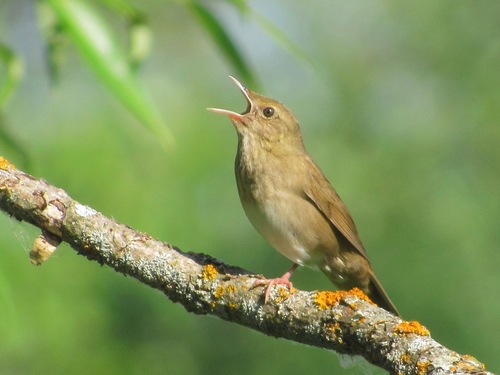
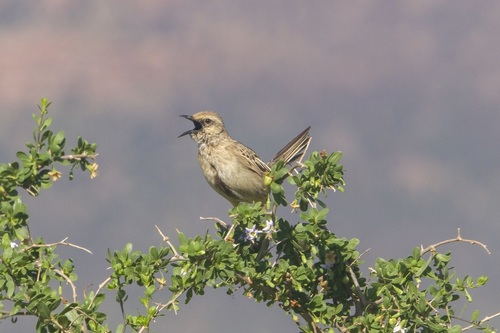
The species' song is a long, high-pitched reeling trill performed with the beak held wide open and the whole body vibrating.
Song Duration and Note Speed
It lasts from a few seconds to several minutes without pauses, and has remarkable speed and complexity, consisting of 52 notes (26 double notes) per second.
Song Perceptibility
Its speed and high pitch mean human ears cannot analyze it without slowed-down recordings.
Song Volume Range
Volume varies between a sound resembling an angler's reel and a distant mowing machine.
Song Audibility Properties
The song is strongly ventriloqual, which makes it difficult to pinpoint the singing bird's location, but it has strong carrying power and is audible at ranges of up to 500 m, even 1 km.
Song Timing and Seasonality
The song can be heard at any time of day or night, but peaks around dawn and dusk, and can be heard from the birds' arrival in April until early August.
Alarm Call
The alarm call is a repeated ticking noise described as "twkit-twkit-twkit".
Song Similarity to Congeners
This species' song shares a similar 'reeling' structure with that of some of its congeners, notably the lanceolated warbler (Locustella lanceolata), Savi's warbler (Locustella luscinioides) and river warbler (Locustella fluviatilis), though all are distinguishable by different tones and speed.
Breeding Range Overview
The common grasshopper warbler breeds in northwest Europe and the western Palearctic.
Breeding Range Details
Its breeding range includes Spain, France, central Italy, Romania, Yugoslavia, the British Isles, Belgium, Netherlands, Germany, Denmark, southern Sweden, southern Finland, the Baltic States and western parts of Russia.
Eastern Range Replacement
Further east, the species is replaced by related species.
Migratory Overwintering Range
In autumn, it migrates south to the Sahel region of tropical Africa, India and Sri Lanka to overwinter.
Breeding Habitat
During the breeding season, the common grasshopper warbler occurs in damp or dry areas with rough grass and bushes, such as fen edges, clearings, neglected hedgerows, heaths, upland moors, gorse-covered areas, young plantations and felled woodland.
Winter Habitat
In winter, it usually occupies similar locations, but little information is available on its winter distribution and habitat, due to its unobtrusive, skulking behaviour.
Feeding Guild
The common grasshopper warbler is insectivorous, feeding on a wide range of invertebrates.
Diet Components
Its diet includes flies, moths, beetles, aphids, dragonflies, mayflies, and their larvae.
Diet and Chick Provisioning
It also eats spiders and woodlice, and chicks are fed aphids, green caterpillars, woodlice and flies.