About Lissemys punctata (Bonnaterre, 1789)
Nomenclature
The scientific name of this species is Lissemys punctata (Bonnaterre, 1789), commonly called the Indian flapshell turtle.
Carapace Shape
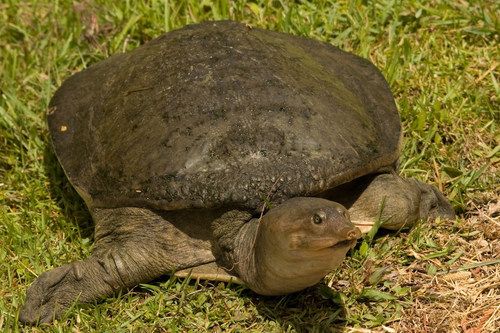
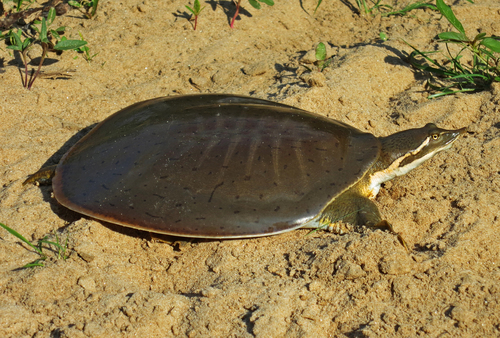
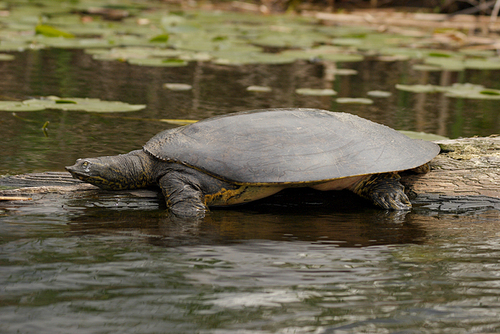
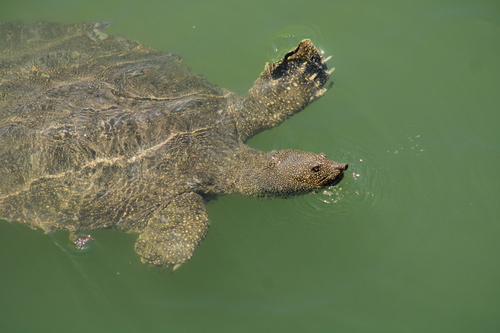
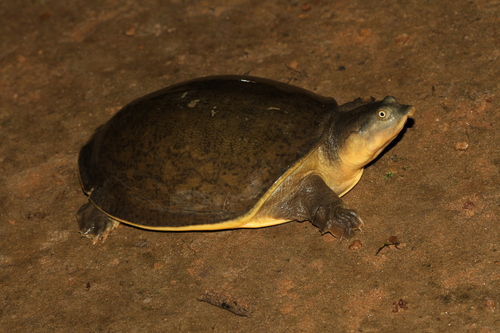
In adult Indian flapshell turtles, the carapace viewed from above is broadly oval, while juvenile carapaces are more circular. The carapace is widest just in front of the hind limbs.
Carapace Measurements
The disc width measures 77–86% of its length, and the carapace is moderately arched, with a shell height that equals 35.0–40.5% of carapace length.
Carapace Structure
The carapace margin is smooth and slightly flared toward the posterior; marginal bones are not joined to the pleurals.
Plastron Characteristics
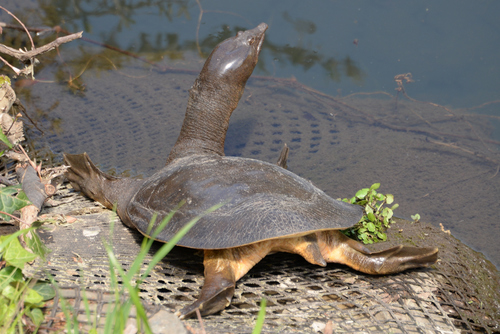
The plastron is large, mostly cartilaginous, and its length measures 88–97% of the carapace length. This species has a pair of large flaps that can close over the hind limbs, plus a smaller flap that covers the tail.
Plastral Callosities
There are seven plastral callosities present.
Head Morphology
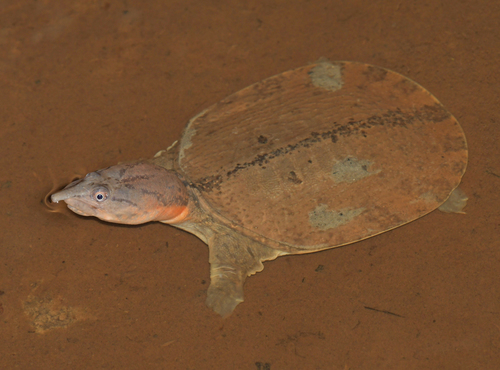
The head is large, with a width that measures 21–25% of the carapace width. The nose is short and stout, the nasal septum has no lateral ridge, the jaw edges are smooth, and the alveolar surfaces are expanded and granular.
Claw Structure
The claws are large and heavy.
Penis Morphology
The penis is thick and oval, with a deep dorsal cleft and four pointed, soft papillae.
Tail Length
The tail is very short in both sexes.
General Carapace Size Range
Recorded adult carapace length ranges from 240 to 370 mm (9.4 to 14.6 in).
Sexual Size Dimorphism
Males can reach a maximum size of up to 23 cm (9 in), while females can reach a maximum size of around 35 cm (14 in).
Native Distribution
This species is naturally distributed across Pakistan, India (where it is common in lakes and rivers), Sri Lanka, Nepal, Bangladesh (in the Indus and Ganges drainages), and Myanmar (in the Irrawaddy and Salween Rivers).
Introduced Range
It has been introduced to the Andaman and Nicobar Islands.
Rajasthan Population Threat
It also inhabits the desert ponds of Rajasthan, where hundreds of individuals are killed every year during dry summers.
Subspecies Distribution
The subspecies Lissemys punctata andersoni occurs in Bangladesh, India, Nepal, and Pakistan.
Albino Morph Record
In 2020, a farmer found a yellow flapshell turtle believed to be an albino morph of this species.
Fossil Record
Miocene-age fossils of this species have been found in Nepal.
Type Locality
The original type locality was listed as "Des grandes Indes" (meaning continental India); this was restricted to Pondicherry, Coromandel Coast, India (11° 56'N; 79° 53'E, on the southeast coast of India) by Webb in 1980.
Habitat Types
Lissemys punctata lives in shallow, quiet, often stagnant water bodies including rivers, streams, marshes, ponds, lakes, irrigation canals, and tanks.
Substrate Preference
It prefers waters with sand or mud bottoms, because this turtle tends to burrow.
Ecosystem Role
It plays an important role in reducing pollution in aquatic ecosystems by feeding on snails, insects, and fragments of dead animals.
Feeding Habit
The Indian flapshell turtle is omnivorous.
Diet Components
Its natural diet includes frogs, shrimp, snails, aquatic vegetation, plant leaves, flowers, fruits, grasses, and seeds.
Medicinal Myth
There is a widespread unproven belief that the shell of Lissemys punctata has medicinal value; the shell is sometimes ground into powder for use in traditional medicines, but no scientific evidence of this claimed efficacy has been found.
Illegal Trade Driver
This false belief enables illegal smuggling of the species, as smugglers rely on the myth to sell turtle products.