About Apalone ferox (Schneider, 1783)
Scientific Name and Morphological Overview
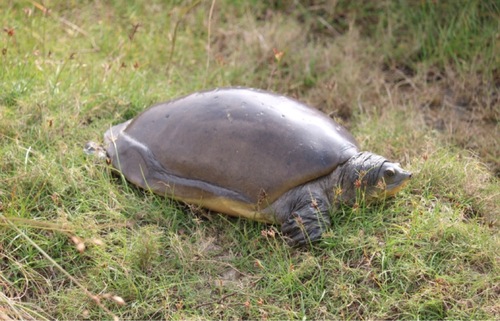
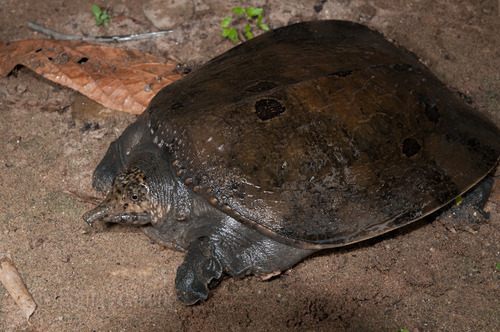
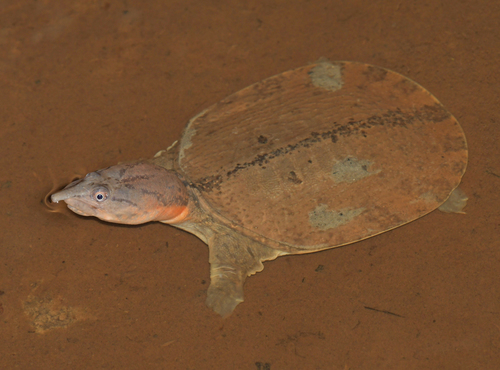
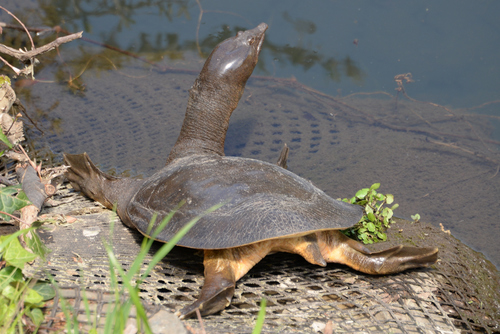
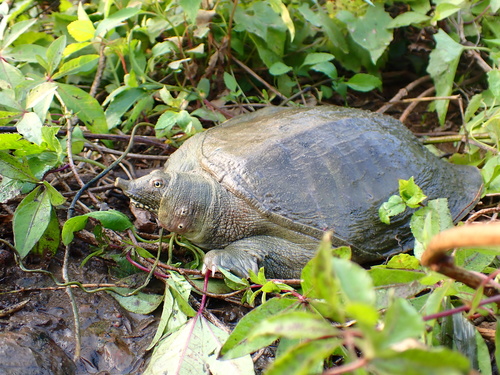
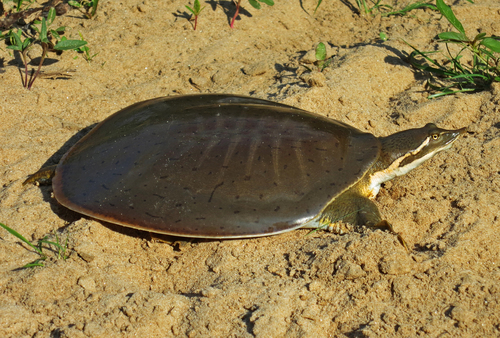
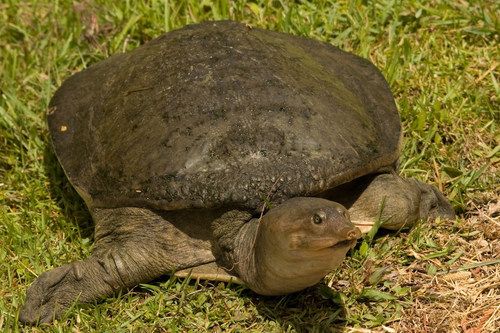
The Florida softshell turtle (scientific name Apalone ferox (Schneider, 1783)) is a large turtle with a flattened, pancake-shaped body, long neck, elongated head with a long snorkel-like nose, and large webbed feet, each bearing three claws.
Unlike most turtles, which have hard shells made of scutes, the Florida softshell turtle has a cartilaginous carapace covered in leathery skin.
Adult Carapace Coloration
Its carapace color ranges from olive green to dark brown, and it has the darkest coloration of all softshell species that live in Florida, alongside two other species: Apalone mutica calvata and Apalone spinifera aspera.
The underside of the turtle is white or cream-colored; this color pattern, called countershading, is a form of camouflage that hides the turtle from potential predators.
Species Size Status
It is the largest softshell turtle species found in Florida and across all of North America.
Straight-line carapace length ranges from 15 to 76 cm (5.9 to 29.9 in), and the species shows significant sexual size dimorphism: adult females are typically 3 to 5 times larger than males.
Male Size Measurements
On average, male carapace length is around 35 cm (14 in) and average body weight is about 2.68 kg (5.9 lb).
Female Size Measurements
Nesting adult females average 6.65 kg (14.7 lb) in weight and 40.1 cm (15.8 in) in carapace length, with the maximum documented weight recorded at 43.6 kg (96 lb).
While females grow larger than males, males tend to have longer tails than females of the same body size, with an average difference of 3 cm.
Hatchling Coloration
Hatchlings have a lighter carapace marked with yellow and orange, a defined rim along the carapace, and matching yellow and orange stripes on the face and neck.
The plastron (underside) of hatchlings is generally dark in color.
Ontogenetic Color Change
As the turtle ages, these bright colors fade and disappear, leaving the dark-brown coloration typical of adult individuals.
Geographic Range
The Florida softshell turtle is found mostly in Florida, but its range also extends into southern parts of Alabama, Georgia, and South Carolina.
It is the only softshell turtle species whose range covers the entire Florida peninsula.
Genus Range Comparison
Of the three species in the Apalone genus, the Florida softshell turtle has the smallest overall geographic range.
Habitat Tolerance
This is a widespread species that lives in almost every type of freshwater habitat, and can even tolerate some brackish environments.
It is not commonly found in water with strong currents, instead preferring slow-moving or still water.
Specific Habitat Types
Habitats it occupies include swamps, lakes, marshes, wet prairies, small rivers, creeks, and even man-made ponds formed in ditches or sinkholes.
Adult Diet and Trophic Role
Adult Florida softshell turtles have a primarily carnivorous diet, and act as major predators in their aquatic ecosystems.
They sit high on the trophic scale, and generally function as secondary or tertiary consumers.
Predators of Adults and Juveniles
Known predators of adult Florida softshell turtles are alligators, while raptors may prey on juveniles.
Nest Predators
Animals that prey on the species' nests include fish crows, foxes, raccoons, skunks, river otters, and American black bears.
Additional Juvenile Predators
Young Florida softshell turtles are also eaten by other turtles (Chelydra, Macroclemys), snakes (Agkistrodon, Nerodia), herons, egrets, and nine-banded armadillos.