About Linaria tristis (L.) Mill.
Taxonomic Identity and Growth Form
Linaria tristis (L.) Mill. is an annual herb that ranges from hairless to sparsely covered in short soft hairs, and grows 10 to 40 centimeters tall, occasionally reaching up to 50 centimeters.
Stem Characteristics
Its stems grow erect or ascending, are slender, and usually branch out from the base.
Leaf Arrangement and Shape
Leaves are arranged alternately, shaped linear to narrowly linear-lanceolate, between 15 and 35 millimeters long (sometimes as short as 10 millimeters) and 0.5 to 2 millimeters wide.
Leaf Features
They have smooth entire margins, are stalkless, and feature a single prominent midrib.
Inflorescence Structure
The inflorescence is a loose raceme, and is sometimes reduced to just one solitary flower growing from a leaf axil.
Pedicel Characteristics
Pedicels are slender and held erect to spreading.
Calyx Morphology
The calyx is deeply divided into five segments; the lobes are linear to narrowly lanceolate, nearly equal in size, and measure 3 to 6 millimeters long.
Corolla Color and Structure
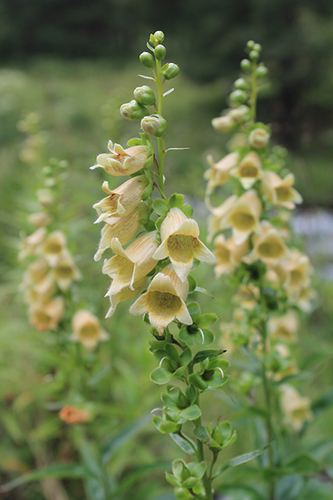
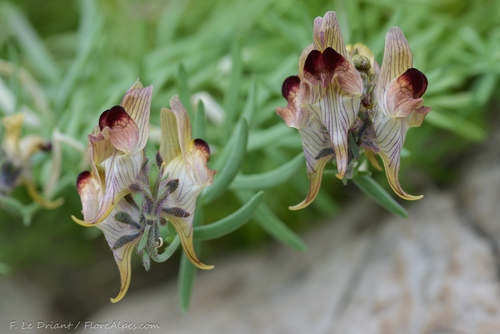
The corolla is zygomorphic and bilabiate, colored pale yellow to yellowish-white, and sometimes marked with faint violet or brownish veins on the flower palate.
Corolla Lobe Structure
The upper lip has two lobes, and the lower lip has three lobes.
Floral Spur Characteristics
The floral spur is slender, straight to slightly curved, and is as long as or longer than the rest of the corolla tube.
Reproductive Floral Parts
There are four stamens, arranged in two pairs of unequal length; the style is slender, and the stigma is capitate.
Fruit Structure
The fruit is a globose to subglobose capsule that dehisces through pores at its apex.
Seed Characteristics
It produces numerous seeds that are discoid, broadly winged, and brown to dark brown, and are adapted for wind dispersal.
Flowering Period
Flowering occurs mainly from March to June, with timing varying based on latitude and seasonal rainfall.
Iberian Distribution
In the Iberian region, Linaria tristis is distributed across central and southern Spain, and parts of Portugal.
Peripheral Distribution Records
Peripheral records of the species from northwestern Africa have been published, but these are often considered marginal or uncertain in regional floras.
Habitat Types
This species grows in open, dry habitats including sandy fields, fallow land, rocky slopes, road verges, and other disturbed sites.
Elevation Range
It occurs from sea level up to approximately 1,200 meters, or 3,900 feet, in elevation.
Soil and Light Preferences
It prefers well-drained, often nutrient-poor soils, and full sun.
Pollination
Linaria tristis is primarily pollinated by bees that are able to reach nectar inside the floral spur, a pollination pattern that is typical for the genus Linaria.
Life Cycle
As a winter or early-spring annual, it completes its full life cycle rapidly before summer drought begins, and persists between growing seasons as a soil seed bank.