About Limosa limosa (Linnaeus, 1758)
Taxonomy and Basic Classification
The black-tailed godwit, with the scientific name Limosa limosa (Linnaeus, 1758), is a large wader species.
Bill Structure
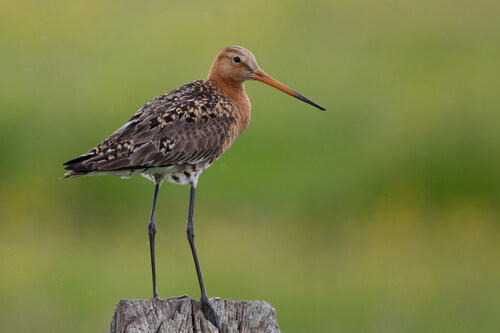
It has a long bill measuring 7.5 to 12 cm (3.0 to 4.7 in), a long neck, and long legs. During the breeding season, the bill has a yellowish or orange-pink base and a dark tip; in winter, the base of the bill is pink.
Leg Coloration
Its legs are dark grey, brown, or black.
Breeding Plumage Sexual Dimorphism
The sexes have similar overall appearance, but in breeding plumage males can be distinguished by their brighter, more extensive orange colouration on the breast, neck, and head.
Non-breeding Adult Plumage
In winter, adult black-tailed godwits have a uniform brown-grey breast and upperparts, which contrasts with the streaked back of the similar bar-tailed godwit.
Juvenile Plumage
Juveniles have a pale orange tint on the neck and breast.
In-Flight Identification Features
When in flight, the species shows easily visible bold black-and-white wings and a white rump.
Ground Identification vs Bar-tailed Godwit
When on the ground, it can be hard to tell apart from the bar-tailed godwit, but the black-tailed godwit’s longer, straighter bill and longer legs are identifying features. Black-tailed godwits share a similar body size and shape with bar-tailed godwits, but stand taller.
Body Size and Wingspan
The species measures 42 cm (17 in) from bill to tail, with a wingspan of 70–82 cm (28–32 in).
Weight and Sexual Size Dimorphism
Males weigh around 280 g (9.9 oz) and females weigh around 340 g (12 oz). Females are around 5% larger than males, and their bills are 12–15% longer.
Vocalization
The most common call of the black-tailed godwit is a strident weeka weeka weeka.
Mortality Rate Data
A study of black-tailed godwits in the Netherlands found a mortality rate of 37.6% in the first year of life, 32% in the second year, and 36.9% in subsequent years.
Oldest Recorded Individual
As of 8 November 2025, the oldest recorded black-tailed godwit is an individual of the Icelandic subspecies L. l. islandica that lived 29 years and 2 months. It was colour ringed as a juvenile on 30 August 1996 on The Wash in Lincolnshire, England, and was subsequently seen 91 times total, including when it was breeding in northern Iceland.
Breeding Range
Black-tailed godwits have a discontinuous breeding range that stretches from Iceland to the far east of Russia.
Natural Breeding Habitat
Their natural breeding habitat includes river valley fens, floodplains at the edges of large lakes, damp steppes, raised bogs, and moorlands.
Secondary Breeding Habitat in Europe
A significant share of the European population now uses secondary habitats: lowland wet grasslands with vegetation reaching up to about 50 cm tall, coastal grazing marshes, pastures, wet areas near fishponds or sewage works, and saline lagoons. Breeding can also occur in sugar beet, potato, and rye fields in the Netherlands and Germany.
Spring and Post-breeding Foraging Habitat
In spring, black-tailed godwits feed mostly in grasslands, and move to muddy estuaries after breeding and for the winter.
African Wintering Habitat
On African wintering grounds, flocks of black-tailed godwits are attracted to swamps, floods, and irrigated paddy fields.
Indian Wintering Habitat
In India, the species uses inland pools, lakes, and marshes, and occasionally brackish lakes, tidal creeks, and estuaries.
Icelandic Population Wintering Range
Black-tailed godwits from the Icelandic population winter mainly in the United Kingdom, Ireland, France, and the Netherlands, though some travel further to Spain, Portugal, and possibly Morocco.
Western European limosa Subspecies Migration
Birds of the limosa subspecies from western Europe migrate south to Morocco, then continue on to Senegal and Guinea-Bissau.
Eastern European Population Migration
Birds from eastern European populations migrate to Tunisia and Algeria, then travel on to Mali or Chad.
Juvenile European Population Movement
Young birds from European populations remain in Africa after their first winter and return to Europe when they reach two years of age.
Asian Population Wintering Range
Asian black-tailed godwits winter in Australia, Taiwan, the Philippines, Indonesia, and Papua New Guinea.
Habitat Preference vs Bar-tailed Godwit
Black-tailed godwits are much more likely to occur on inland wetlands than the more coastal bar-tailed godwit.
General Migration Range
They migrate in flocks to western Europe, Africa, south Asia, and Australia.
British Isles Seasonal Population Difference
While this species can be found in Ireland and Great Britain year-round, the birds present in different seasons are not the same populations. Local breeding birds depart in autumn, and are replaced in winter by the larger Icelandic subspecies.
Vagrant Occurrence Range
Black-tailed godwits occasionally appear in the Aleutian Islands, and rarely on the Atlantic coast of North America.
General Diet Composition
Black-tailed godwits mainly eat invertebrates, and also consume aquatic plants during winter and migration.
Breeding Season Prey
In the breeding season, their prey includes beetles, flies, grasshoppers, dragonflies, mayflies, caterpillars, annelid worms, and molluscs. Occasionally, they eat fish eggs, frogspawn, and tadpoles.
Aquatic Feeding Behavior
In water, their most common feeding method is vigorous probing, which can happen up to 36 times per minute, often with the head completely submerged.
Terrestrial Feeding Behavior
On land, black-tailed godwits probe into soft ground and also pick prey items from the surface.