About Ligustrum lucidum W.T.Aiton
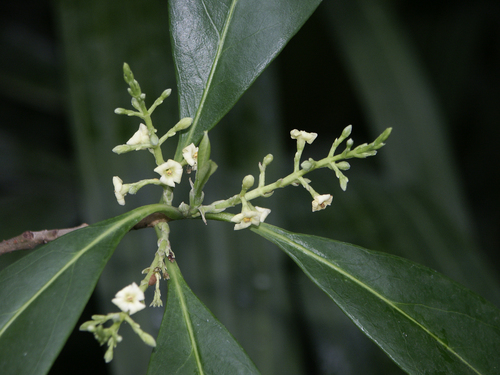
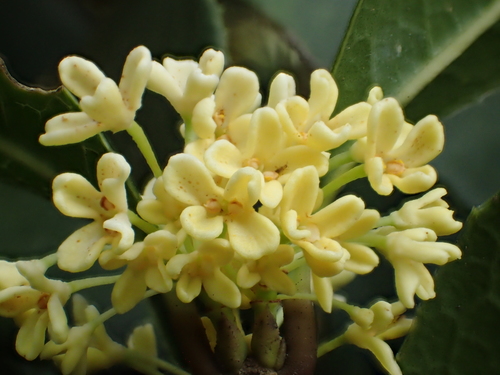
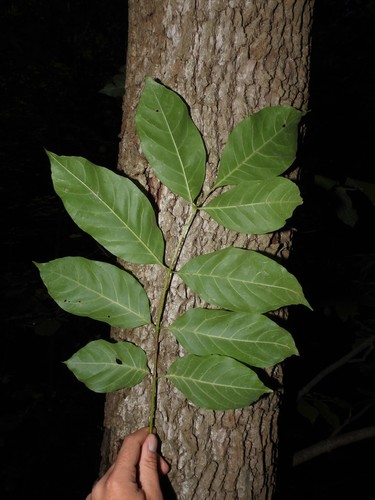
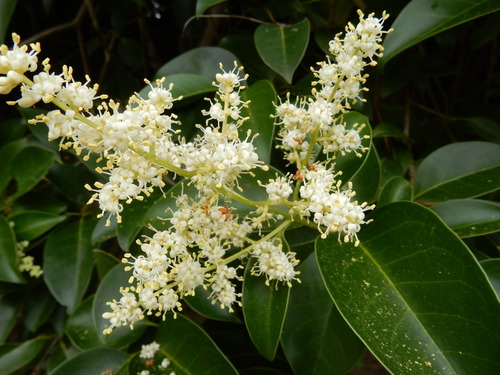
Ligustrum lucidum W.T.Aiton is an evergreen tree that grows to 10 meters (33 feet) in both height and width. Its leaves are arranged opposite one another, have a glossy dark green color, and measure 6–17 centimeters (2.4–6.7 inches) long by 3–8 centimeters (1.2–3.1 inches) wide. Its flowers resemble those of other privet species; they are white or near-white, produced in panicles, and carry a strong fragrance that some people find unpleasant. This species is native to southern China, and has become naturalized in Spain, Italy, Algeria, the Canary Islands, New Zealand, Lesotho, South Africa, Japan, Korea, Australia, Norfolk Island, Chiapas, Central America, Argentina, Uruguay, southern and southeastern Brazil, the southern United States (including California, Arizona, Maryland, and the southeast from Texas to North Carolina), and a small village in the UK called Lidlington. Ligustrum lucidum is frequently grown as an ornamental tree, and is sometimes cultivated in variegated forms. It is also one of multiple privet species used to create dense evergreen hedges, which can be trained to a desired size and shape through regular pruning. The species itself, along with its variegated cultivar 'Excelsum Superbum', has received the Royal Horticultural Society's Award of Garden Merit. In some regions where it has been introduced, Ligustrum lucidum has become an invasive species, including in urban areas of the southeastern United States. It is classified as a noxious weed in New South Wales, Australia, and is also included on New Zealand's National Pest Plant Accord. It is the source of Chinese insect wax, produced by the insect Ericerus pela, which is used to make candles. In traditional Chinese medicine, the seeds of Ligustrum lucidum are known as nu zhen zi (translated as female chastity seed/berry). They are believed to nourish liver and kidney yin and jing, and are used to treat tinnitus (ringing in the ears), vertigo (dizziness), premature graying of the hair, and soreness or weakness of the lower back and knees. Because of the traditional belief that the berries nourish the liver, they are also used to treat eye disorders that involve red or dry eyes, blurred vision, and eye pain.