About Cartrema americana (L.) G.L.Nesom
Common Names and Growth Form
Cartrema americana, commonly known by the common names American olive, wild olive, or devilwood, is an evergreen shrub or small tree.
Native Distribution
It is native to southeastern North America: in the United States, it grows from Virginia to Texas; in Mexico, it grows from Nuevo León south to Oaxaca and Veracruz.
Taxonomic History
This species was formerly classified as Osmanthus americanus. After researchers found that the original genus Osmanthus was polyphyletic, it was moved to the newly segregated genus Cartrema, along with Osmanthus floridanus and five Asian species.
Mature Height
Cartrema americana typically reaches 4 to 7 meters (13 to 23 feet) in height, and rarely grows as tall as 11 meters (36 feet).
Leaf Characteristics
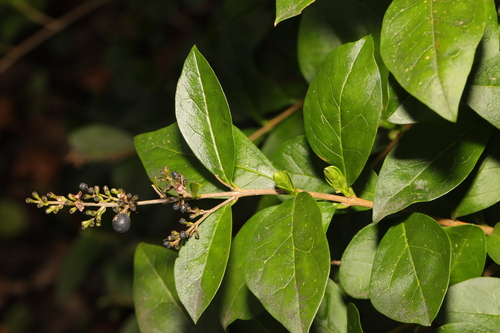
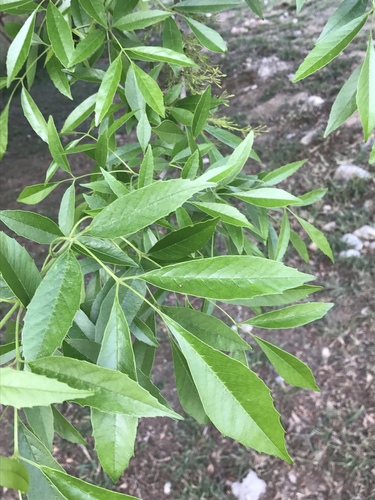
Its leaves measure 5 to 14 centimeters (2.0 to 5.5 inches) long and 2 to 4 centimeters (0.79 to 1.57 inches) wide, and have smooth, entire margins.
Flower Traits
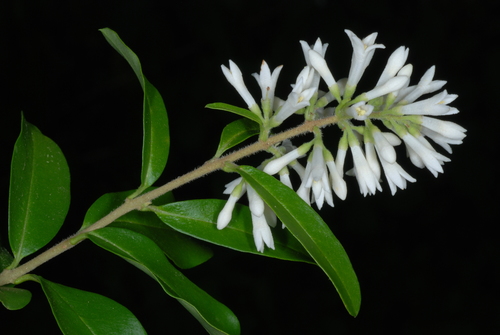
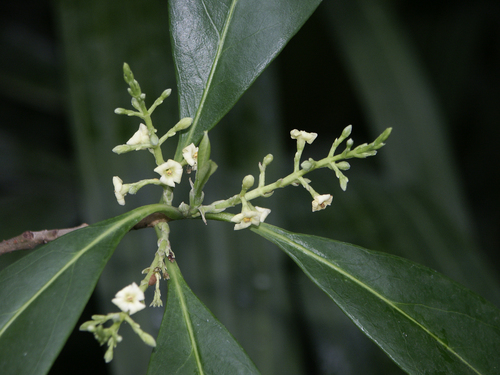
The plant produces small, white, strongly fragrant flowers in early spring; each flower is 1 centimeter long and has a four-lobed corolla.
Fruit Characteristics
Its fruit is a globose, dark blue drupe 6 to 15 millimeters (0.24 to 0.59 inches) in diameter, which contains a single seed.
Cultivation Use
It is cultivated as an ornamental garden plant, valued for its fragrant flowers.