About Leucospermum tottum (L.) R.Br.
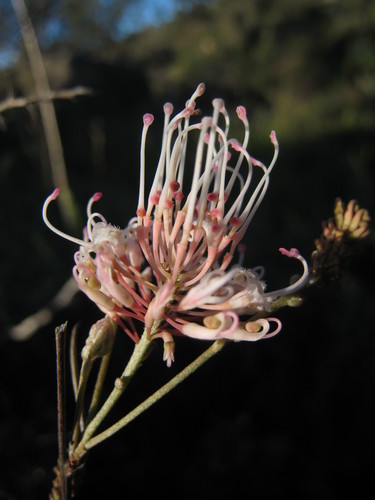
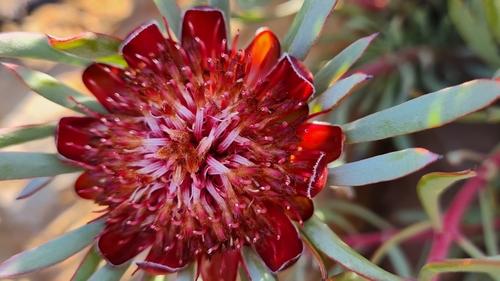
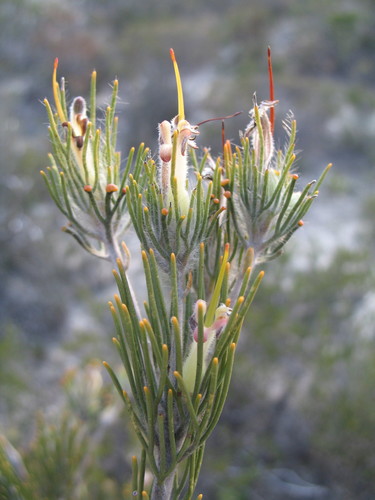
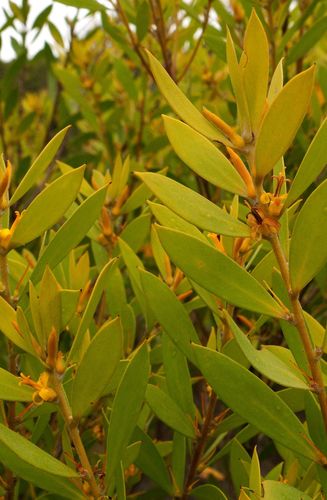
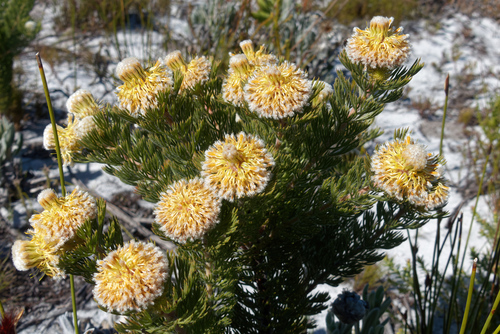
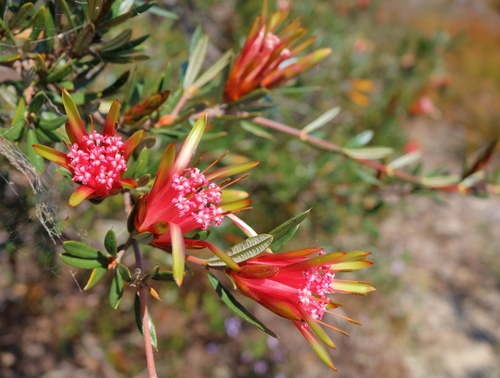
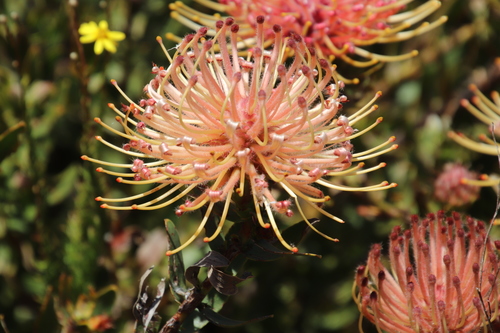
Leucospermum tottum (L.) R.Br., commonly called the ribbon pincushion, is an upright evergreen shrub that reaches up to 1½ m (4½ ft) in height and 2 m (6 ft) in diameter. It produces horizontal flowering stems that are 5–7 mm (0.2–0.3 in) in diameter, flushed reddish, and covered in soft hairs that may be lost as the plant ages. Its widely spaced leaves grow at right angles to the stem, lack a stalk and hairs, and range in shape from lance-shaped with a pointed tip to long oval, sometimes with a heart-shaped base. Leaves are 2½–6 cm (1–2.4 in) long and ½–1½ cm (0.2–0.6 in) wide, with a bony tip that sometimes has two or three bony teeth. Flower heads usually grow individually, start as low cone-shaped buds and become disc-shaped when flowers open, measuring 9–15 cm (3.6–5 in) in diameter on a 2–3 cm (0.8–1.2 in) long stalk. The common shared base of flowers in a single head is broadly cone-shaped, 3–4 cm (1.2–1.6 in) high and around 4 cm wide. Bracts subtending the entire flower head are broadly oval to oval with a pointed tip, 10–15 mm (0.4–0.6 in) high and 4–7 mm (0.16–0.28 in) wide, with two papery wings on the lower half. They are hairless except for a regular line of straight hairs along the margin, and stand out or slightly overlap each other. The bract subtending each individual flower is broadly oval, about 15 mm (0.6 in) long and 8 mm (0.32 in) broad, with a soft papery texture, woolly hair near the base, powdery hair to hairlessness higher up, and a pointed tip. The 4-parted perianth is 4–4½ cm (1.6–1.8 in) long and pale pink. The lower part of the perianth, which remains merged when the flower opens, is about 7 mm (0.28 in) long, hairless or slightly powdery, and somewhat flattened sideways. The middle perianth segments (or claws) are each about 1 mm (0.04 in) wide, covered in fine soft hairs; the claw facing the edge of the flower head is free, while the other three remain fused, and all four claws are strongly curled backward. The upper perianth segments (or limbs), which enclose the pollen presenter in the bud, are oval to lance-shaped, each about 3 mm long and 1½ mm wide, dull carmine to brownish in color and slightly covered in soft hairs. The four anthers are each attached to the limbs almost without a filament. A straight, slender yellow style around 5 cm (2 in) long emerges from the center of the perianth; it is initially slightly curved toward the center of the head, but straightens with age. The thickened tip of the style, called the pollen presenter, is egg-shaped with a pointed tip, 1–1½ mm (0.04-0.06 in) long, with an oblique surface on the side facing the head center, and the stigma groove running across the very tip. The ovary is surrounded by four opaque, line- to awl-shaped scales about 2 mm (0.08 in) long.
In terms of distribution, habitat and ecology, this species can be found from Eselbank in the Cederberg in the north, through the Koue Bokkeveld, Ceres, Worcester, and the Paarl Mountains, to Villiersdorp in the south. Individual plants usually grow alone in rugged mountainous terrain on acidic, nutrient-poor soils, at altitudes between 300–1800 m (1000–6000 ft), though a few dense populations occur near Villiersdorp and on the Zuurvlakte near Tulbagh. Growing conditions vary widely across its range: from dry, hot north-facing slopes in the Cederberg, with annual precipitation of 400–500 mm (15–20 in), to moist, cool south-facing slopes where annual rainfall can reach as high as 1500 mm (60 in). In all locations, rain falls mostly during the southern winter. Leucospermum tottum var. glabrum is restricted to Jan du Toit's Kloof in the western Hex River Mountains. Fruits fall to the ground around two months after flowering. Ants collect the fallen fruits and carry them to their underground nests, where they eat the pale, soft elaiosome, leaving the brown, hard, smooth seed protected from the periodic wildfires common to the fynbos biome this species grows in. After fire kills most standing vegetation, the seeds germinate to regenerate the population at the site.