About Lambertia formosa Sm.
Taxonomic Identity and Growth Form
Lambertia formosa Sm. is a spreading shrub that grows up to 2 metres (7 feet) tall, with one or more stems emerging from a woody base called a lignotuber.
New growth is covered in fine brownish hair.
Leaf Arrangement
Stiff leaves grow in whorls, typically of 3, though sometimes 4 to 6, and are linear to narrow-oblanceolate in shape.
Leaf Dimensions and Shape
They range from 1 to 8 cm (0.4–3 in) long and 0.2–0.7 cm wide, and end in a pointed apex.
Flowering Period
Flowers can appear at any time of year, but are most common in spring and summer, from September to January.
Inflorescence Bracts
Greenish and reddish bracts cover the base of the inflorescences.
Inflorescence Structure and Color
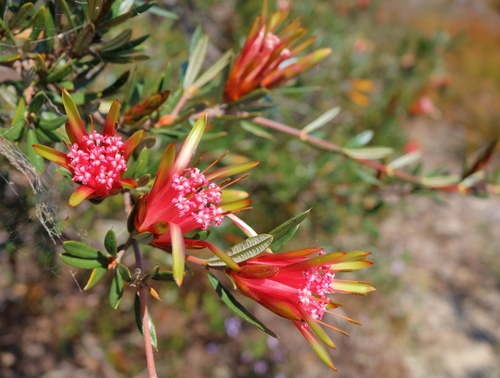
Almost all inflorescences are made up of seven smaller individual flowers called florets—fewer than 1% of flowerheads have six or eight florets—and inflorescences can be shades of red or pink.
Perianth and Style Dimensions
The tubular perianths are 4.5 cm (1.6 in) long, with styles extending an additional 1–1.5 cm (0.5 in) beyond the perianth.
Fruit Size
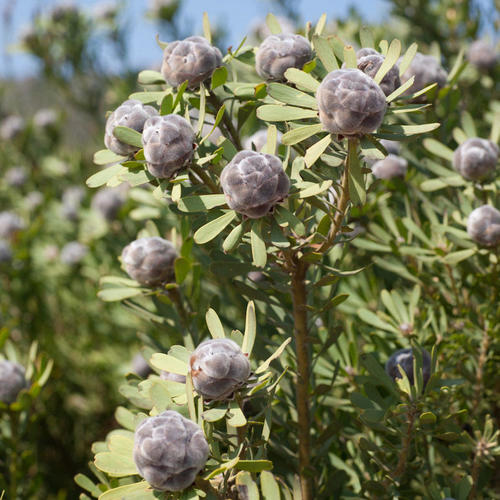
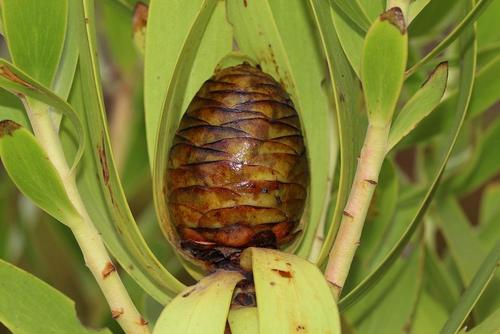
After flowering, woody fruit develop that measure 2–3 cm by 1–2 cm.
Fruit Features and Maturation
The fruit have two 1–1.5 cm sharp horny protuberances and a 0.5 cm 'beak'; they start pale green and fade to grey-brown as they mature.
Seed Characteristics and Release
Each woody follicle holds two flat, winged seeds that are retained inside the fruit until a fire releases them.
Endemic Range
This species is endemic to New South Wales.
Distribution Area
It occurs on or east of the Great Dividing Range from the Braidwood area north to Port Stephens, and also grows in parts of northern New South Wales around Grafton, and between Red Rock and Yamba.
Altitude and Rainfall Range
In the Sydney Basin, it grows at altitudes from sea level up to 1100 m (3600 ft), in areas with annual rainfall between 800 and 1400 mm (32–55 in).
Habitat and Soil Preferences
It grows in heathland, mallee shrubland, and dry sclerophyll forest, and is predominantly found on sandy or rocky soils.
Clay Soil Occurrence
In one heathland community between Lake Munmorah and Redhead, L. formosa grows at least partly on clayey soils.
Heathland Associated Species
Among the associated species in heathland are Angophora hispida (dwarf apple), Leptospermum trinervium (paperbark teatree), Banksia oblongifolia (rusty banksia), and Banksia ericifolia (heath banksia).
Woodland Associated Trees
Associated woodland trees include Eucalyptus sieberi (silvertop ash), Angophora costata (smooth-barked apple), Angophora bakeri (narrow-leaved apple), Corymbia gummifera (red bloodwood), Corymbia eximia (yellow bloodwood), Eucalyptus sclerophylla (scribbly gum), and Eucalyptus piperita (Sydney peppermint).
Lake Munmorah Heathland Associates
In the Lake Munmorah to Redhead heathland, it grows under mallee forms of Eucalyptus capitellata (brown stringybark) and Eucalyptus umbra (broad-leaved white mahogany), alongside shrubby Melaleuca nodosa (prickly-leaved paperbark), Hakea teretifolia (dagger hakea), Allocasuarina distyla (scrub she-oak), rusty banksia, and swathes of Themeda triandra (kangaroo grass).
Post-Fire Regeneration
After bushfire, Lambertia formosa regenerates by resprouting from its woody lignotuber, and it is also serotinous—it holds a seed bank in its canopy that is released after fire.
Post-Fire Flowering Peak
Flower production by regrowing plants peaks two to three years after fire.
Fire Interval Impact on Reproduction
A field study conducted in Brisbane Water National Park north of Sydney found that plants that experienced two short intervals (less than seven years) between bushfires had lower reproductive output (measured as fewer follicles) than plants in areas with no or only one short inter-fire interval.
Lifespan
Individual plants can live for over 60 years.
Pollination Adaptations
The red or pink flower colour, tube length, and nectar properties indicate that the species is pollinated by honeyeaters, which perch while consuming nectar.
Recorded Honeyeater Pollinators
Observed foraging honeyeater species include Lichenostomus leucotis (white-eared honeyeater), Phylidonyris niger (white-cheeked honeyeater), Phylidonyris novaehollandiae (New Holland honeyeater), Manorina melanocephala (noisy miner), Acanthochaera chrysoptera (little wattlebird), Acanthorhynchus tenuirostris (eastern spinebill), and Lichenostomus chrysops (yellow-faced honeyeater).
Honeyeater Abundance Correlate
Higher numbers of honeyeaters are found near plants that produce more flowers.
Herbivorous Insect Associates
Caterpillars of the Australian cup moth species Xylorycta strigata eat this plant's leaves and burrow into its wood, and the plant also hosts caterpillars of the cup moth species Mecytha fasciata.
Early Cultivation Introduction
Lambertia formosa was one of the first Australian plant species introduced to cultivation in England.
Initial Seed Import
In 1788, seed was sent from Botany Bay to the Lee and Kennedy nursery in Hammersmith, west London.
Cultivated Varieties
Two varieties were grown, one designated 'var. longifolia'.
First Cultivated Flowering Record
The first recorded flowering of this cultivated species was on a plant grown by J. Robertson of Stockwell in July 1798.
Early Propagation Notes
The following year, Andrews noted that it can be easily grown from cuttings, and thrives in peat soil.
19th Century English Cultivation Challenges
In 1809, Knight reported that it required more heat and closer care than other Australian plants, and therefore would never be widely cultivated in England.
Modern Cultivation Requirements
In cultivation today, L. formosa grows readily when given a sunny position and good drainage, though it tolerates a range of soils and some shade.
Cultivation Benefits
Its flowers attract birds, and provide a year-round source of food.
Pruning Response
It responds well to pruning.
Propagation Methods
Seeds germinate within 25 to 60 days after sowing, and firm young growth is the best material for propagation via cuttings.
Fertiliser Requirements
Fertilisers are generally not needed, but slow release low-phosphorus fertilisers are tolerated.
Climate Tolerance
The species is frost-hardy, and grows in temperate to subtropical climates.
Phytophthora Resistance
Inoculation experiments show that unlike all other members of its genus, Lambertia formosa is resistant to dieback caused by Phytophthora cinnamomi.
Rootstock Potential
This gives it potential for use as a rootstock for grafting Western Australian Lambertia species, all of which are highly sensitive to this root rot.
Common Name Origin
Its common name 'honey flower' comes from the large quantities of clear nectar produced by its flowers.
Aboriginal Nectar Use
This nectar was a source of nourishment for Australian Aboriginal peoples.
Post-Colonisation Nectar Consumption
After European colonisation, explorers, escaped convicts, and children were recorded sucking nectar directly from the flowers.
Leichhardt Nectar Use Account
Explorer Ludwig Leichhardt wrote that he often bit off the base of a tuft of Lambertia formosa flowers to suck the delightfully sweet honey out when he was tired and thirsty.
Nectar Ingestion Effects
Headaches and nausea have been reported after ingesting large quantities of the nectar, though no toxic substance has been identified in it.
Parkinson Illustration
The species was illustrated by Sydney Parkinson, an artist on HM Bark Endeavour's 1768–1771 voyage to the Pacific.
Banks' Florilegium Engraving
A colour botanical engraving based on Parkinson's original work is included in Banks' Florilegium.
George Raper Depictions
First Fleet midshipman and artist George Raper depicted the species in two works: an untitled watercolour study from around 1788, and Bird Of Point Jackson from 1789.
Floral Emblem Proposal
Writer and illustrator George Collingridge included the flower in several of his designs, and unsuccessfully promoted it to be the floral emblem of Australia.
'Mountain Devils' Craft Use
Hand-crafted decorative figures called 'mountain devils' have been made using the mature woody fruit as a head, with pipe cleaners, wool, and fabric scraps for the rest of the figure.
Tourist Souvenir Use
These souvenirs were sold to tourists in the Blue Mountains.