About Protea canaliculata Andrews
Growth Form
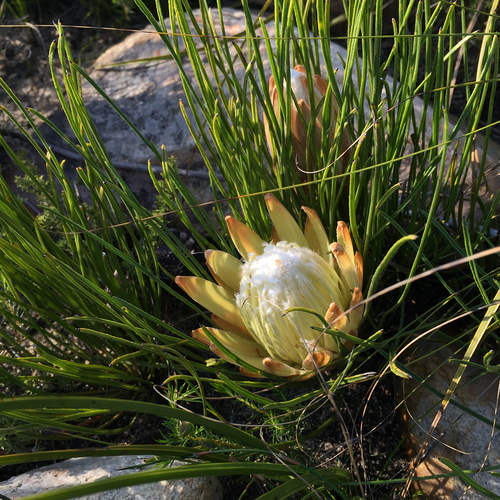
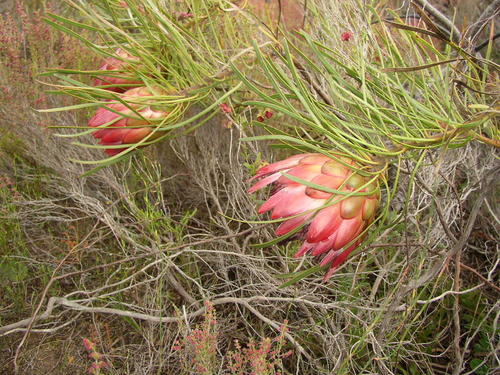
Protea canaliculata is a shrub that can grow up to 1.2 metres tall. Its branches are glabrous, red, and can be decumbent, somewhat decumbent, or upright.
Leaf Morphology
The linear, glabrous leaves are 13–18 cm (5–7 inches) long and only 1.6 to 3.2 mm wide, ending in a sharp to somewhat-sharp pointed tip. The leaves narrow at their bases and have indistinct veins.
Leaf Channel Trait
The upper surface of the leaf is concave, forming a distinct deep channel along the back of the leaf – this trait is the source of the species' specific epithet.
Flowering Period
This protea blooms in autumn and winter, from March to June, with peak flowering in May.
Inflorescence Size
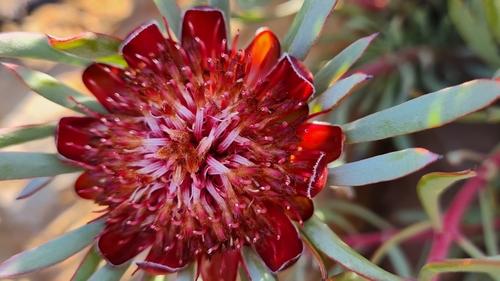
The inflorescence is sessile, meaning it has no stalk. It grows 4.4 cm (1.75 inches) tall and 3.8 cm (1.5 inches) in diameter.
Outer Bract Characteristics
Nine series of bracts surround the flower head: the outer bracts are ovate with a rounded apex, covered in silky hairs, and have a hairy fringe (ciliate) along their margins.
Inner Bract Characteristics
The inner bracts are more oblong and concave, also ciliate, but have less silky hair; the innermost bracts are glabrous and the same length as the flowers.
Reproductive System
The species is monoecious, with both male and female reproductive structures present in each individual flower.
Fruit Traits
The fruits are woody and persistent, meaning they stay attached to the plant after the plant senesces.
Fire Response
Wildfires will destroy mature individuals, but the seeds survive fires, held in caps within the dried inflorescence. When seeds are released after a fire, they are dispersed by wind.
Endemic Range
This plant is endemic to the central region of the Western Cape province of South Africa. It occurs in the mountain ranges of the Little Karoo, from the Hex River Mountains to the Waboomsberg and Groot Swartberge, and also grows at Ouberg Pass in Western Cape.
Population Distribution
The species usually occurs in low densities as scattered plants across a wide area, but it may occasionally be found growing clustered together in dense stands.
Habitat Soil and Altitude
Ecologically, Protea canaliculata grows in rocky, open, quartzite- or sandstone-derived soils at altitudes ranging from 800 to 1,500 metres, or alternatively 700 to 1,700 metres.
Vegetation Habitat
It grows in montane fynbos habitat.
Pollinators
Pollination was originally thought to likely be carried out by birds, but both rodents and birds are now considered to pollinate this species.