About Leucospermum mundii Meisn.
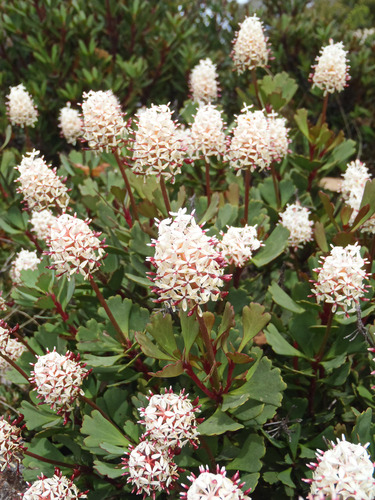
Leucospermum mundii Meisn. is an upright, rounded, heavily branching shrub ½–1 m (1½–3 ft) tall, that grows from a basal trunk. Its flowering stems are 5–6 mm (0.20–0.24 in) thick, and appear grey from a thick layer of felty hairs. Leaves are greyish, either felty hairy or hairless, broadly wedge-shaped to very broadly obovate, 5–8½ cm (2–3½ in) long and 2–6½ cm (¾–2½ in) wide. They are nearly stalkless or have a very short stalk, and bear 7 to 17 teeth near their tip. Flower heads are whorled or turbinate in shape, 2–4 cm (0.8–1.6 in) long and 1–2 cm (0.4–0.8 in) wide, and grow in clusters of 3 to 10. Each flower head sits on a stalk 1–1½ cm (0.4–0.6 in) long. The common base shared by all flowers in one head is flattened, and 6–7 mm (0.24–0.28 in) wide. Bracts that subtend the entire flower head are lance-shaped to oval, 5–7 mm (0.20–0.28 in) long and 3–5 mm (0.12–0.20 in) wide, with a pointed tip. They overlap, are cartilaginous in texture, densely covered in silky hairs, and have a slightly hooked, thickened tip. The individual bract that subtends each single flower is rectangular, about 5 mm (0.20 in) long and 2 mm (0.08 in) wide, obtrullate (it embraces the flower at its base). It is cartilaginous in texture, densely covered in soft hairs, and has a hooked tip. The 4-merous perianth is initially yellow, and 16–18 mm (0.64–0.72 in) long. The lowest, fully fused section of the perianth, called the tube, is dull carmine, 8–10 mm long, narrow cylinder-shaped, hairless at its base, and inflated with powdery hairs in its upper section. The middle section (or claws), where the perianth splits lengthwise, is initially pale yellow and turns orange with age. It is made up of four very thin, coarsely hairy lobes, each of which curves back individually near its tip. The upper section (or limbs), which encloses the pollen presenter while the flower is in bud, consists of four pale green, pointed, elliptic to lance-shaped lobes around 1½ mm (0.06 in) long. A straight, thread-shaped, pale yellow style 2½–2⅞ cm (1–1⅛ in) long emerges from the perianth. The thickened tip of the style, called the pollen presenter, is thin, bluntly cylinder-shaped, ½–1 mm (0.02–0.04 in) long, and hard to distinguish from the rest of the style. A groove that acts as the stigma runs across the very tip of the pollen presenter. The ovary is surrounded by four opaque, blunt, thread-shaped scales 2–2½ mm (0.08–0.10 in) long. The genus Leucospermum belongs to the subtribe Proteinae, which consistently has a basic chromosome number of twelve, with 2n=24. Leucospermum mundii occurs only in the Langeberg mountain range, and is known from just a few locations between Garcia's Pass above Riversdale and Goedgeloof Peak above Swellendam. It grows on northern slopes in southwest-facing gorges, at an altitude of 300–900 m (1000–3000 ft). It occupies very well-drained sites on Table Mountain Sandstone, with an average annual precipitation between 635 and 1015 mm (25–40 in), which is relatively high for the Cape region. The species grows in dense fynbos vegetation, where the dominant associated species include multiple Restionaceae, Protea eximia, P. neriifolia, and Leucadendron eucalyptifolium.