About Hakea actites W.R.Barker
Taxon Naming and Growth Form
Hakea actites W.R.Barker is a prickly shrub or tree that reaches between 0.3 and 5 metres (1.0 to 16.4 ft) in height, and it forms a lignotuber. Its smaller branches are covered in silky to dense short matted hairs.
Leaf Characteristics
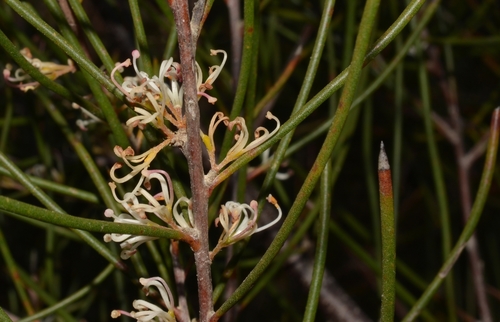
The light green leaves are smooth and needle-shaped, measuring 3.5 to 13.5 centimetres (1.4 to 5.3 in) long and 0.3 to 1.3 millimetres (0.0 to 0.1 in) in diameter, ending in a sharp point 1–2 mm (0.04–0.08 in) long.
Inflorescence and Flower Count
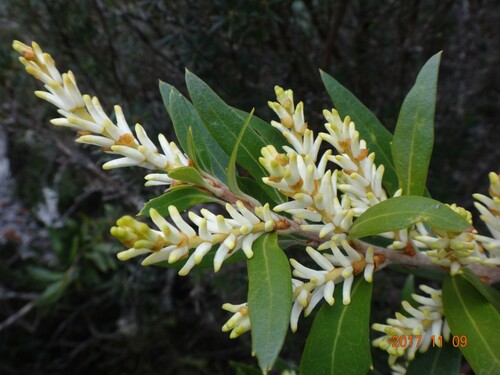
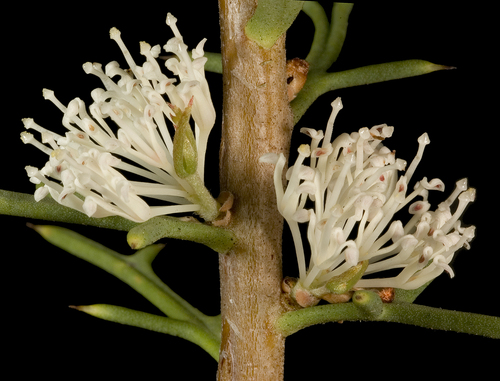
Its inflorescence holds 1 to 6 white flowers that grow in clusters in leaf axils.
Flower Stalk Morphology
Flower stalks are 0.6–1 mm (0.02–0.04 in) long and covered in short rust-coloured matted hairs. The pedicel is 1.8–3 mm (0.07–0.1 in) long, covered sparsely or fully with matted silky white and rust-coloured hairs.
Perianth Features
The perianth is 3.1–4.3 mm (0.1–0.2 in) long, white and smooth, and occasionally bluish-green with a powdery film.
Fruit Morphology
The fruit are wrinkled and egg-shaped, 20–35 mm (0.8–1 in) long and 16–25 mm (0.6–1 in) wide, ending in a smooth rounded beak with obscure horns. Fruits occasionally grow coarse blister-like protuberances.
Flowering Period
Flowering occurs from May to September.
Similar Species
Hakea actites resembles the more well-known Hakea sericea.
Geographic Distribution
This species is found in swampy coastal locations ranging from around Hervey Bay in south-eastern Queensland (in the north) to just north of Coffs Harbour in New South Wales (in the south).
Habitat and Plant Communities
It grows well in damp sand to sandy clay soils, and is often a member of open wallum heathland and Eucalyptus forest communities.
Horticultural Use
In horticulture, it is a very hardy species that can be grown from seed, and is well suited to coastal swampy locations.
Ecological Value
Its prickly growth habit and profuse flowering provide protection, nesting sites, and nectar for small birds.