About Grevillea dryandri R.Br.
Taxonomic Identity and Growth Form
Grevillea dryandri R.Br. is a spreading to erect shrub that typically grows to 0.3–2 metres in height, which is 0.12–0.79 inches in foot units.
Leaf Structure
It has divided leaves 40–280 mm (1.6–11.0 in) long, with between ten and sixty linear to narrowly lance-shaped lobes per leaf.
The lobes measure 40–210 mm (1.6–8.3 in) long and 0.7–3 mm (0.028–0.118 in) wide, and have edges that are turned down or rolled under.
Leaf Surface Characteristics
The lower surface of the leaflets is covered in silky hairs.
Inflorescence Structure
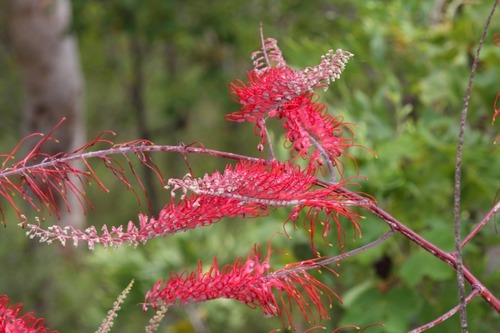
The flowers are arranged in clusters along a rachis that is 100–600 mm (3.9–23.6 in) long, with each individual flower growing on a 4.5–10 mm (0.18–0.39 in) long pedicel.
Flower Color and Morphology
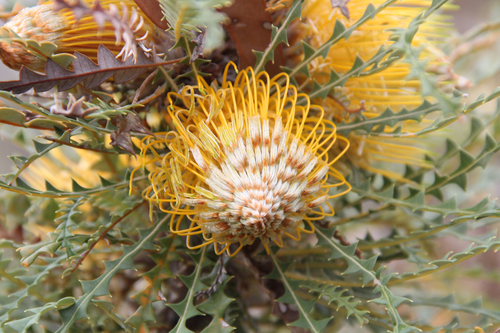
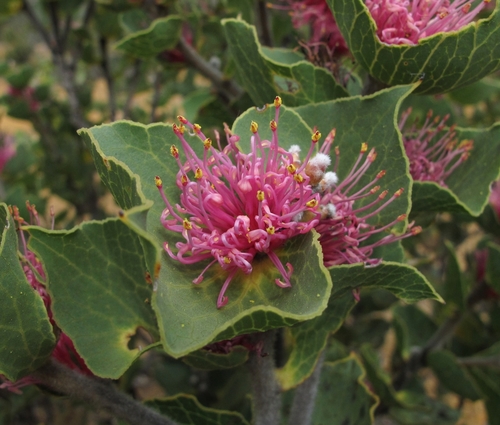
Flowers can be red, orange-red, pink, or white, and have a pistil that is 41–50 mm (1.6–2.0 in) long.
Flowering Period and Fruit
Flowering time varies between subspecies, and the fruit that forms after flowering is a thin-walled follicle 7.5–15 mm (0.30–0.59 in) long.
Subspecies Recognition
Two subspecies are recognized with distinct distributions and habitats.
Subspecies dasycarpa Habitat and Range
Subspecies dasycarpa grows in shrubby woodland on sandstone, ranging between Mataranka, Daly River and the Gove Peninsula in the northern Northern Territory of Australia.
Subspecies dryandri Habitat
Subspecies dryandri grows in open woodland or open shrubland, often in rocky locations.
Subspecies dryandri Range
Its range extends from the Kimberley region of Western Australia, to the Northern Territory north of approximately Tennant Creek, and into northern Queensland, reaching mainly as far east and south as Mount Isa and Normanton.