About Leucospermum heterophyllum (Thunb.) Rourke
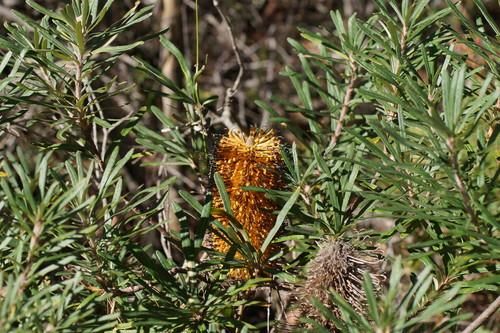
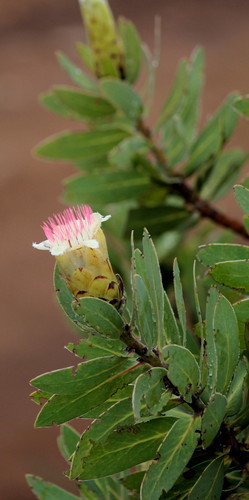
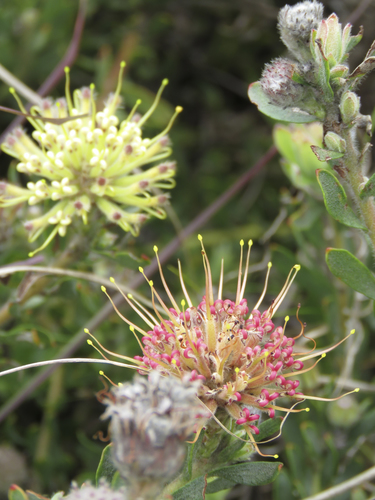
Leucospermum heterophyllum is an evergreen, low shrublet that grows 10–15 cm (3.9–5.9 in) high. It spreads from a thick, sturdy rootstock 5–10 cm (2.0–3.9 in) wide, forming a dense mat that reaches 1–6 m (3.3–19.7 ft) in diameter. Basal stems are also sturdy, growing up to 5 cm thick. Long trailing branches radiate outward along the ground, and most flower heads grow from slender short side shoots that are 1–2 mm (0.039–0.079 in) thick. Its leaves are narrow, either linear and slightly fanning out, or lance-shaped with the widest point near the tip. They are 2–3 cm (0.79–1.18 in) long and 3–6 mm (0.12–0.24 in) wide, stalkless, twisted at the base and oriented more or less upward. Most leaves have a broad tip with three teeth that have hard bony points; leaves are usually covered in short felty hair when young, and lose this hair as they mature. The flower heads are globe-shaped, 2–3 cm (0.79–1.18 in) in diameter, and sit on a stalk 1–2 cm (0.39–0.79 in) long. The common base that all flowers in a head attach to is low and egg-shaped, 2–3 mm (0.079–0.118 in) across. This base is surrounded by an involucre made of overlapping, cartilaginous, softly hairy oval bracts that are 3–4 mm (0.12–0.16 in) long and 1–2 mm (0.039–0.079 in) wide, with a recurved pointed tip that carries a sparse tuft of long stiff hairs. The bracts that subtend each individual flower are woolly on the outside, broadly oval, about 3 mm long and 2 mm wide, with a pointed tip. The perianth is 4-merous, and about 1.5 cm (0.59 in) long. The lower tube portion, where lobes remain fused after the flower opens, is about 4 mm (0.16 in) long, hairless at its base, and constricted with slight felty hair where it transitions to the middle claw portion where the perianth splits lengthwise. These claws are covered in felty hair, pale greenish yellow in colour, and all coil back once the flower opens. The upper limb portion, which encloses the pollen presenter in the bud, is made of four dark brown, lance-shaped lobes about 1 mm (0.039 in) long. The lobes are softly hairy on the outside, and each is fused on the inside to a yellow anther that is 0.75 mm (0.03 in) long with a pointed tip. A straight style 18–21 mm (0.71–0.83 in) long emerges from the perianth; it tapers in its upper third, is pale yellow when young, and turns dull carmine as it ages. The thickened tip of the style, called the pollen presenter, is yellow, shaped like a cone or egg, and has a groove across its very tip. The ovary is surrounded by four opaque, linear to thread-shaped scales about 2 mm (0.079 in) long. The flowers of Leucospermum heterophyllum are scented. This species is endemic, restricted to just a few square miles on the Agulhas plains between Bredasdorp to the northeast, Elim to the west, and Soetendalsvlei to the south. It grows most often on exposed conglomerate Table Mountain Sandstone and quartzite at a few sites near Bredasdorp. It rarely grows on weathered fine-grained graywacke, a Malmesbury series conglomerate, and exceptionally grows on Tertiary sand deposits. It occurs in low, sparse vegetation made up primarily of Restionaceae, Erica species, and Thymelaeaceae. Across its native range, average annual precipitation is 375–500 mm (14.8–19.7 in), and rain falls mostly during the southern winter. After wildfires, this species can regularly sprout from its basal branches, which are somewhat fire-resistant thanks to their reasonably thick bark.