About Leucospermum grandiflorum (Salisb.) R.Br.
Common Names and Growth Form
Leucospermum grandiflorum, commonly called the grey-leaf fountain pincushion, is an evergreen, upright shrub growing up to 2½ m (7½ ft) high, with a single robust main stem. Its flowering stems curve upward or grow upright from the base, and carry short crinkly hairs along with straight, silky hairs around ½ cm (0.2 in) long.
Leaf Characteristics
The softly hairy leaves are broadly elliptic to elliptic-oblong, 5–8 cm (2.0–3.2 in) long and 2–3 cm (0.8–1.2 in) wide. Most leaves have three bony-tipped teeth near the tip, while a small number lack teeth entirely.
Flower Bud and Opening Pattern
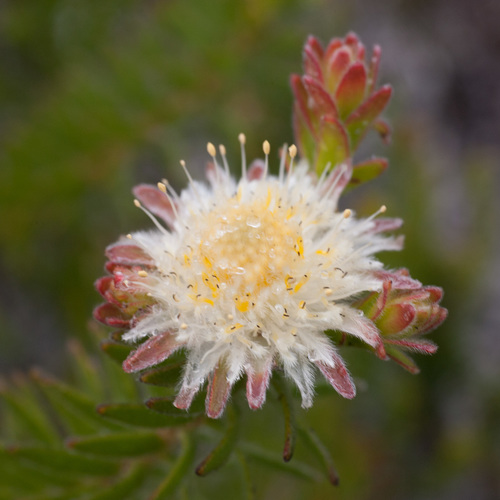
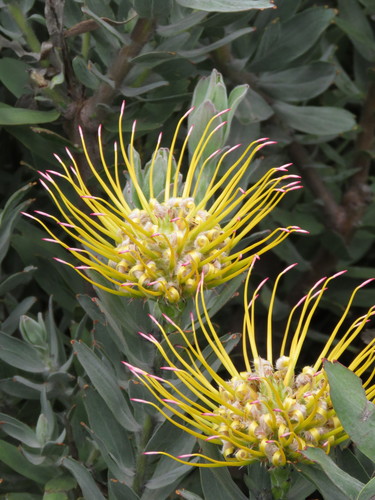
Young, hair-covered flower buds are shaped like a spinning top, and flowers open in a spiral pattern. Flower heads start out egg-shaped, becoming more flattened over time, and measure 10–12 cm (4.0–4.8 in) across.
Flower Head Stalk and Receptacle
They are almost stemless or have a stalk no longer than 1½ cm (0.6 in). The common base that holds all flowers in one head is narrowly cone-shaped with a pointed tip, about 4 cm (1.6 in) long and 1 cm (0.4 in) across at its base.
Involucral Bracts
Bracts subtending the entire flower head are pointed oval in shape, 1–1½ cm (0.4–0.6 in) long and 5–8 mm (0.20–0.32 in) wide. They are cartilaginous near the base and papery towards the tip, with a regular row of short equal-length hairs along their edges and a tuft of longer, stiff straight hairs at the tip.
Individual Flower Bracts
Bracts subtending each individual flower are about 2 cm (0.8 in) long and ½ cm (0.2 in) wide, pointed lance-shaped with a slightly recurved tip. They are very thickly woolly at the base, and covered in fine silky hair further up.
Perianth Overall
The 4-merous perianth is 4½–5 cm long, and pale greenish yellow in color.
Perianth Tube
The lower part of the perianth, called the tube, where lobes remain fused after the flower opens, is about 7 mm (0.28 in) long, hairless, narrow at the base and somewhat bulging near the upper end, slightly compressed sideways.
Perianth Claws
The middle split sections of the perianth, called claws, are 9–12 mm (0.36–0.48 in) long, curve back from their base when the flower opens, and bear a few slender spreading hairs.
Perianth Limbs
The upper perianth sections, which enclose the pollen presenter inside the bud, consist of four narrowly lance-shaped limbs around 8 mm (0.32 in) long, narrowly lance-shaped to linear with a pointed tip, covered in fine silky hairs.
Style Characteristics
A style 7–7½ cm (2.8–3.0 in) long emerges from the perianth; it is initially yellow, later turning crimson, and is slightly obliquely deflected clockwise.
Pollen Presenter
The pollen presenter, a structure that receives pollen from anthers while the flower is still in bud, is cylinder-shaped with a pointed tip, 6–8 mm (0.24–0.32 in) long. It is initially pink, later turning carmine-colored, and has a groove that functions as a stigma across its very tip.
Ovary Scales
The ovary is subtended by four opaque awl-shaped scales around 3 mm (0.12 in) long.
Distribution Range
This species grows in Boland Granite Fynbos vegetation, found in the hills around Durbanville, on Paarl mountain, on the Paardeberg near Malmesbury, and in a few isolated spots in the Berg River valley. It was at risk of extinction in the 1970s.
Soil Preferences
It mostly grows on clayey soils formed by the weathering of Cape Granite, and occasionally occurs on Tertiary sand overlying Malmesbury gravel.
Habitat and Altitude
It thrives in hot, dry, exposed habitats, often on north-facing slopes, growing alongside other low shrubs such as renosterbos and kapokbossie at altitudes between 80–500 m (250–1600 ft).
Climate Precipitation
The average annual precipitation in these regions is 380–635 mm (15–25 in), falling mostly in the winter months from May to August.
Climate Temperature
Night temperatures may occasionally drop below 0 °C here.
Pollination
The large flowers of Leucospermum grandiflorum are mostly pollinated by Cape sugarbirds.
Fruit Dispersal
Mature fruits fall to the ground around two months after flowering. Native ants gather the fallen fruits and carry them to underground nests, where they eat the elaiosome (fleshy seed coating).
Seed Protection
The remaining hard, slippery seed cannot be carried away by the small ants' jaws, so it stays underground, protected from seed-eating mice and birds and from overhead fires.
Seed Germination
Seeds germinate in early winter when increased temperature fluctuations or charwood chemicals washed underground by seeping rain indicate that wildfire has cleared the surface vegetation cover.