About Persoonia chamaepeuce Lhotsky ex Meisn.
Growth Habit
Persoonia chamaepeuce is a prostrate shrub, with branch tips sometimes growing up to 30 centimetres (12 inches) tall. Young branches are more or less glabrous.
Leaf Characteristics
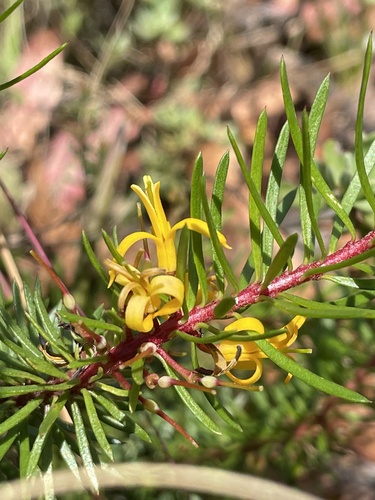
It bears smooth, glabrous, linear leaves that are 8–25 mm (0.3–1 in) long and 1–2 mm (0.04–0.08 in) wide; leaves may be straight or curved, with a slightly concave upper surface.
Flower Arrangement
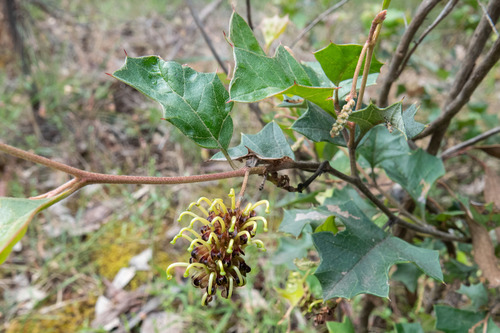
Flowers grow singly in leaf axils, on a glabrous pedicel 3–6 mm (0.1–0.2 in) long. Each flower has four hairy tepals 9–13 mm (0.4–0.5 in) long, fused at the base with rolled-back tips.
Reproductive Structures
The central style is surrounded by four yellow anthers that are also joined at the base with rolled-back tips, giving a cross-like shape when viewed end-on. Each anther has a spine around 1 mm (0.04 in) long at its tip, and the ovary is glabrous.
Flowering and Fruit
Flowering occurs from December to March, and is followed by yellowish-green, oval-shaped drupe fruit around 10 mm (0.4 in) long and 6 mm (0.2 in) wide.
Similar Species Distinction
This species is sometimes confused with the similar Persoonia chamaepitys, which differs by having more crowded terete leaves.
Common Name and Habitat
This plant, commonly called the dwarf geebung, grows in woodland and forest habitats across tablelands from south of the New England district in New South Wales to Victoria. In Victoria it is widely distributed and locally common in montane and subalpine areas.
Horticultural Use
In horticulture, this geebung works well as a groundcover, and its flowers are prominently displayed. It can be propagated from seed, and requires a sunny position with well-drained soil.
Cultivation Traits
Although it grows slowly, it adapts easily to cultivation in temperate climate areas.