About Petrophile brevifolia Lindl.
Growth Form
Petrophile brevifolia is a low, multi-stemmed shrub that is either erect or spreading, and does not form a lignotuber.
Size and Branchlet Features
It typically grows 0.2 to 2 meters (7.9 inches to 6 feet 6.7 inches) tall, and has glabrous branchlets and leaves.
Leaf Characteristics
The leaves are needle-shaped, 10 to 50 millimeters (0.39 to 1.97 inches) long, with a sharply-pointed tip around 2 millimeters (0.079 inches) long.
Flower Head Structure
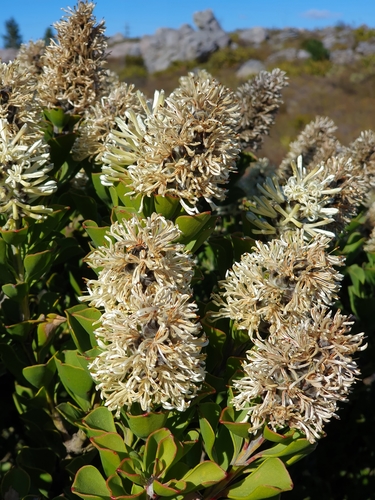
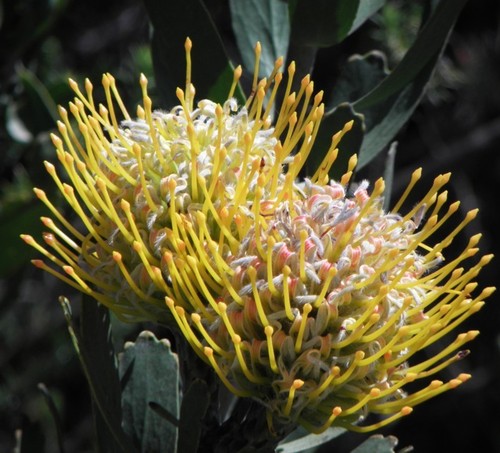
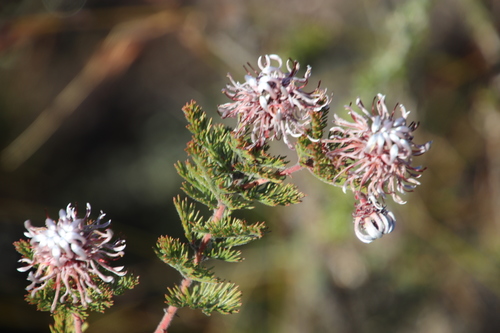
Flowers are arranged at the ends of branchlets in sessile, spherical heads that are 10 to 15 millimeters (0.39 to 0.59 inches) in diameter.
Involucral Bracts
Many linear or tapering involucral bracts grow at the base of these flower heads.
Individual Flower Features
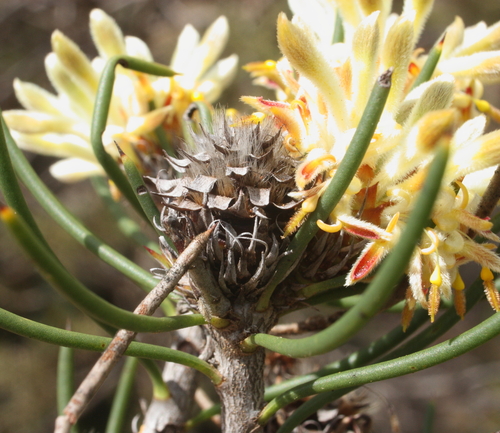
The individual flowers are 12 to 20 millimeters (0.47 to 0.79 inches) long, yellow, creamy yellow or white, and hairy.
Flowering Period
Flowering takes place from June to December.
Fruit Characteristics
The fruit is a nut that is fused with other nuts to form an oval to spherical head about 10 to 20 millimeters (0.39 to 0.79 inches) long.
Habitat
This species of petrophile grows in shrubland, heath and woodland.
Distribution
It is widespread and common across the southwest of Western Australia, ranging from Kalbarri National Park to Ongerup.