About Coeligena lutetiae (Delattre & Bourcier, 1846)
Taxonomic Information
This species, the buff-winged starfrontlet, has the scientific name Coeligena lutetiae (Delattre & Bourcier, 1846).
Size
It reaches approximately 14 cm (5.5 in) in total length. Males weigh 6.9 to 7.2 g (0.24 to 0.25 oz), while females weigh about 6.6 g (0.23 oz).
Shared Morphological Features
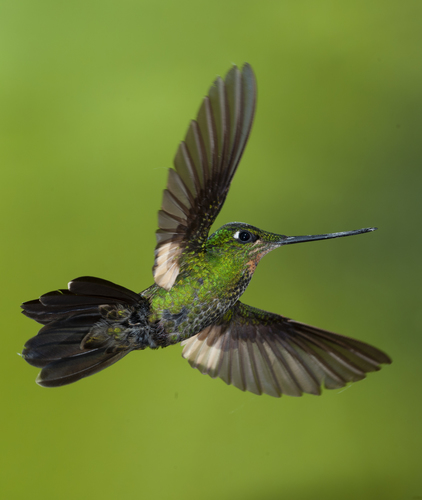
All individuals of both sexes have a long, black, slightly upturned bill and a small white spot located behind the eye. Both sexes also have a forked tail, though the female’s tail fork is less deeply indented than the male’s.
Nominate Male Plumage
Males of the nominate subspecies have velvety black upperparts and a glittering green forehead. They possess a violet gorget, and the rest of their underparts are dark green. Their wings are dark with a large cinnamon-buff patch, and their tail is colored bronzy black.
Nominate Female Plumage
Females of the nominate subspecies have shining dark green upperparts. Their throat is cinnamon-buff, and the rest of their underparts are golden green with pale feather fringes. They share the same cinnamon-buff wing patch seen in males, but their tail is colored bronzy green.
C. l. albimaculata Male Features
For subspecies C. l. albimaculata, males match the nominate subspecies in all features except their wing patches, which are almost white.
C. l. albimaculata Female Features
Females of this subspecies have a paler throat than nominate females, a cinnamon tinge to their underparts, and the golden green of their underparts is also less iridescent.
Nominate Subspecies Distribution
The nominate subspecies of buff-winged starfrontlet ranges from the Central Andes of Colombia, south through the Andes of Ecuador, to far northern Peru.
C. l. albimaculata Distribution
Subspecies C. l. albimaculata occurs only in northwestern Ecuador.
Habitat
The species as a whole inhabits cloudforest, elfin forest, and the lower edges of páramo.
Elevation Range
It can be found at elevations between 2,600 and 4,800 m (8,500 to 15,700 ft), and is most common around 3,000 m (9,800 ft).