About Lesbia nuna (R.Lesson, 1832)
Common Name Introduction
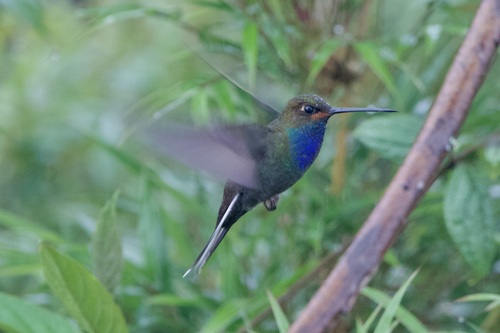
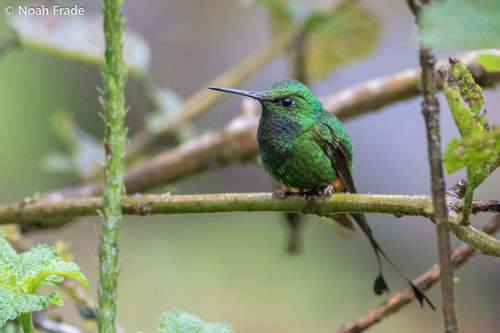
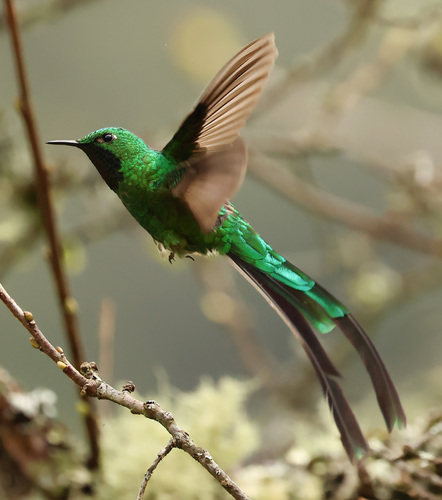
This is the description of Lesbia nuna, commonly known as the green-tailed trainbearer.
Male Size Measurements
The male measures 15.3 to 17 cm (6.0 to 6.7 inches) in total length, which includes its 10.6 to 13.6 cm (4.2 to 5.4 inch) long tail.
Female Size Measurements
Females are approximately 11.6 cm (4.6 inches) long in total, including their 4.5 to 6.2 cm (1.8 to 2.4 inch) tail.
Weight and Bill Traits
The entire species weighs between 3.1 and 4.3 g (0.11 to 0.15 oz), and has a short, straight, black bill.
Nominate Male Plumage
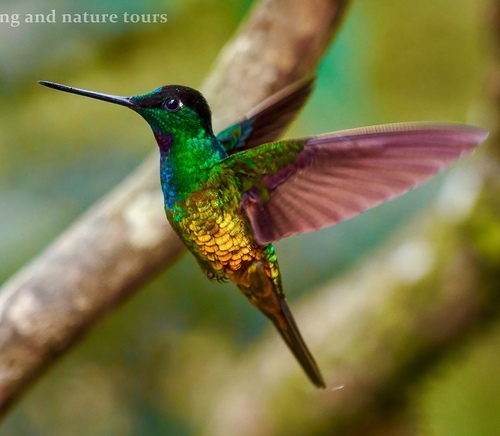
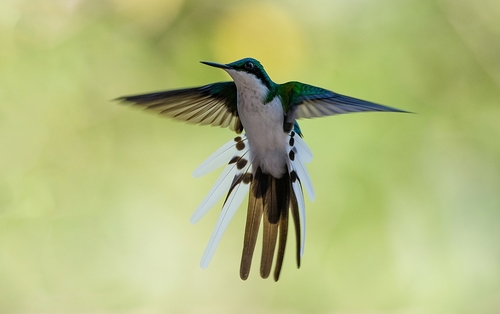
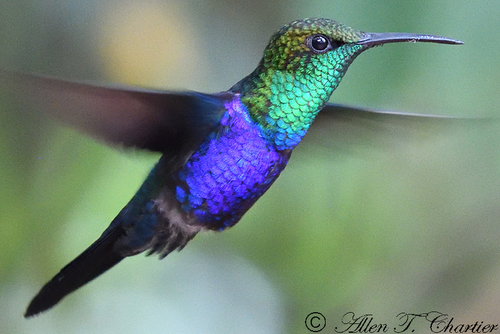
Males of the nominate subspecies are almost entirely glittering emerald green; their throat is iridescent emerald green, and their lower belly is grayish with green dots.
Nominate Male Tail Traits
Their tail is long, forked, and black, with green-tipped feathers.
Nominate Female Plumage
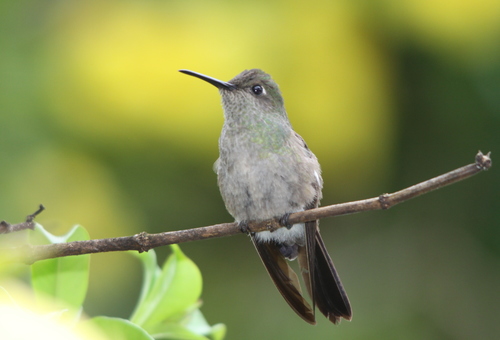
The nominate female is similar to the male, but has white underparts with glittering green spots and a shorter tail.
Juvenile Plumage
Juveniles resemble adult females, but juvenile males additionally have green spots on the throat.
L. n. gouldii Male Traits
Males of subspecies L. n. gouldii are similar to the nominate subspecies, but smaller in size, with a shorter bill and more green coloration on the tail.
L. n. gracilis Traits
L. n. gracilis is also similar to the nominate, but has a shorter and thicker bill, and buffy undertail coverts with green spots.
L. n. pallidiventris Traits
L. n. pallidiventris has a longer bill than both L. n. gouldii and L. n. gracilis, and paler, less blue-green upperparts than the nominate subspecies.
L. n. huallagae Traits
L. n. huallagae has a longer bill than L. n. pallidiventris, but the bill is still shorter than that of the nominate; its plumage is somewhat bronzy green, and its belly is paler than the nominate's belly.
L. n. aureliae Traits
L. n. aureliae has rich golden bronze plumage and a creamy buff belly.
IOC Recognized Subspecies Distributions
Six subspecies are recognized by the IOC, with the following distributions: L. n. gouldii is found in the Eastern Andes of northeastern Colombia and the Central Andes of southern Colombia; L. n. gracilis is found in the Andes of northern and central Ecuador; L. n. aureliae is found in the Andes of southeastern Ecuador from Azuay Province to Loja Province; L. n. pallidiventris is found in the Andes of northern and central Peru from eastern Piura Department to western Huánuco Department; L. n. huallagae is found in the Huallaga River valley in central Huánuco, Peru; L. n. nuna is found in the Andes of southwestern Peru and northern Bolivia.
L. n. boliviana Distribution
When L. n. boliviana is treated as separate from L. n. nuna, it occurs in Bolivia from La Paz Department to Cochabamba Department.
Venezuelan Record SACC Position
An old historical record of L. n. gouldii from Venezuela has been questioned for multiple reasons, and the South American Classification Committee (SACC) of the American Ornithological Society does not include Venezuela in the species' range.
Venezuelan Record Other Taxonomy Positions
The IOC includes Venezuela in the range with a question mark, and the Clements taxonomy notes the single old record.
Habitat Preferences
The green-tailed trainbearer mostly inhabits secondary woodland and brushy slopes, but also occurs in Polylepis woodland and páramo.
Elevation Range
It is found at elevations ranging from 1,700 to 3,800 m (5,600 to 12,500 ft).