About Heliothryx auritus (J.F.Gmelin, 1788)
The black-eared fairy (Heliothryx auritus, first described by J.F.Gmelin in 1788) measures 10.1 to 13.7 cm (4.0 to 5.4 in) in length and weighs 4 to 6.3 g (0.14 to 0.22 oz).
Nominate Male Plumage
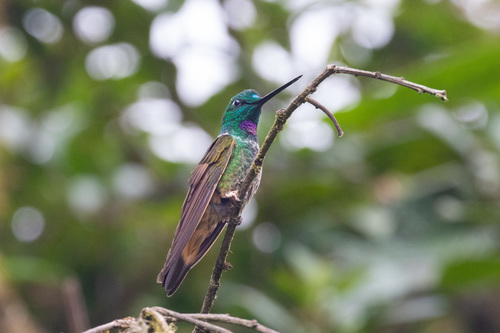
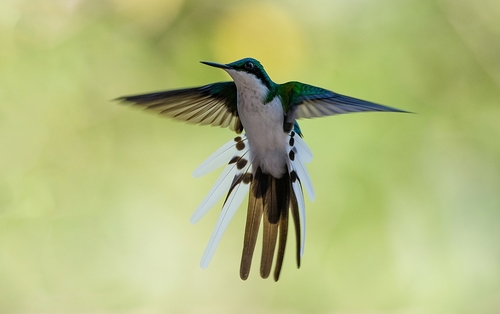
The nominate subspecies male has bright shiny green upperparts, pure white underparts, and a long pointed tail with darkish blue central feathers and white outer feathers. It has a black patch below the eye, glittering purple ear coverts, and a short, straight, black bill.
Female Plumage
The female is similar in most respects, but lacks purple facial markings, has grayish dots on its throat and breast, and has a black band at the base of the three outer pairs of tail feathers. Immature birds are otherwise similar to females, but have cinnamon fringes on the plumage of their upperparts.
Subspecies Male Plumage
Male H. a. auriculatus have green coloring on the chin and sides of the throat. Male H. a. phainolaemus have variable green coloring on the throat and chin, and female H. a. phainolaemus do not have the gray spots on the underparts that nominate females have.
Vocalizations
The species' calls include "a short high-pitched 'tsit' and richer 'tchip', repeated at intervals."
Nominate Subspecies Range
The nominate subspecies of black-eared fairy is distributed from southeastern Colombia and eastern Ecuador through northern Brazil north of the Amazon River to northeastern Venezuela, and continues through the Guianas.
H. a. phainolaemus Range
H. a. phainolaemus is found in the Brazilian states of Pará and Maranhão, south of the Amazon River.
H. a. auriculatus Range
H. a. auriculatus has two distinct separate populations: one is located in eastern Peru, central Bolivia, and central Brazil south of the Amazon River as far east as the Tapajós River, while the other is in southeastern Brazil from Bahia south to São Paulo state, with irregular records even further south.
Habitat Preferences
The species inhabits the interior and edges of wet primary and secondary forest. It is most common at elevations below 400 m (1,300 ft), but has been recorded as high as 800 m (2,600 ft).
Movement Patterns
The black-eared fairy is generally believed to be sedentary, though some irregular movements have been reported in southern Brazil.
Foraging Height
The black-eared fairy mostly forages in the forest mid-story and canopy, though it will forage at all levels in terra firme forest.
Nectar Feeding Behavior
It feeds on nectar from a wide variety of flowering plants, gaining access both by inserting its bill into the flower corolla and by piercing the base of the flower to rob nectar.
Insect Feeding Behavior
It also catches and feeds on small insects while flying, a feeding behavior that differs from that of the purple-crowned fairy.